
Reviewed · HIKING & TREKKING
4 Days Mount Meru Climbing | Hiking | Trekking Tour
The sunrise summit is worth the early alarm. This four-day Mount Meru trek combines a proper mountain challenge with wildlife sightings in Arusha National Park, making it a strong warm-up before Kilimanjaro. I especially like the armed ranger escort, which adds safety and gives the first day a real safari feel, and the narrow summit ridge, where you look into the crater on one side and toward Kilimanjaro on the other. The main catch is that Mount Meru is not a gentle practice walk. The summit night is steep, cold, and long, and park fees are not included in the advertised $2,600 price.
You sleep in mountain huts rather than tents, eat three breakfasts, three dinners, and four lunches, and have airport and gate transfers included. The experience suits fit hikers who want a quieter mountain route, but I would not book it as a casual add-on without preparing your legs and lungs first.
In This Review
- Key points at a glance
- Why Mount Meru makes a smart Kilimanjaro warm-up
- Day 1: Momela Gate to Miriakamba Hut
- Day 2: The steep climb to Saddle Hut
- Day 3: Rhino Point, Cobra Point, and the summit ridge
- Day 4: Returning through forest and grassland
- What the $2,600 price really covers
- Food, huts, and the practical rhythm of the climb
- Who should book this Mount Meru route?
- Booking details and cancellation terms
- Should you book the four-day Mount Meru climb?
- FAQ
- Where does the Mount Meru climb take place?
- How long is the Mount Meru tour?
- What time does the tour start?
- Is an armed ranger required?
- Where do you sleep during the climb?
- Is wildlife viewing included?
- Are meals included?
- Are park fees included in the price?
Key points at a glance
- Wildlife on the lower slopes: You may see elephants, giraffes, buffalo, zebras, monkeys, antelope, and other animals before the trail rises into the forest.
- A mandatory armed ranger: Because the route passes through Arusha National Park, the climb includes a ranger escort.
- A dramatic volcanic route: The path follows the crater rim toward Rhino Point, Cobra Point, and the summit ridge above the Ash Cone.
- Hut accommodation: Nights are spent at Miriakamba Hut and Saddle Hut, not in tents.
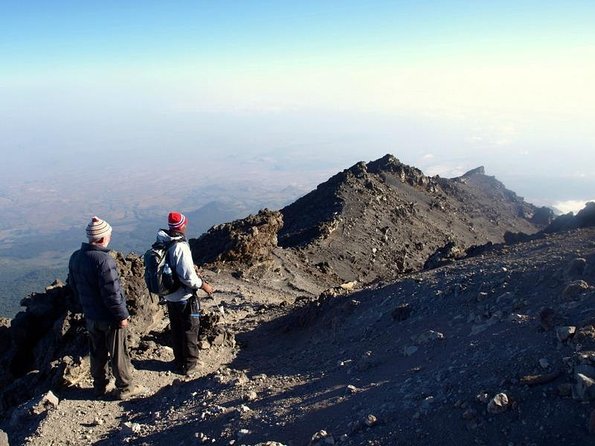
- A serious summit day: The early start around 1:30 a.m. leads to a 10 to 12-hour day with a summit at 4,565 or 4,566 meters.
- Useful Kilimanjaro preparation: The climb gives you a practical test of pacing, cold-weather gear, altitude, and endurance before a longer Kilimanjaro route.
Why Mount Meru makes a smart Kilimanjaro warm-up
Mount Meru reaches about 4,568 meters and is Tanzania’s second-highest mountain. It is also described as Africa’s third-highest peak. The exact ranking matters less than what the mountain gives you: a compact, demanding climb with a summit high enough to show you how your body handles altitude.
I like the four-day format because it lets you experience several mountain zones without rushing every day. You begin in montane forest, pass through moorland, and finish in alpine desert conditions near the summit. That change is easy to feel in your legs, your breathing, and the temperature.
The route also gives you a useful rehearsal for Kilimanjaro. You practice walking slowly, eating on a schedule, sleeping at altitude, and starting a summit push in the middle of the night. One past participant used Meru as a warm-up and planned to climb Kilimanjaro just two days after reaching the Meru summit. That is possible in a well-planned trip, but the schedule leaves little time to recover.
The most important lesson is simple: shorter does not mean easy. The route covers fewer days than many Kilimanjaro itineraries, but the summit day includes a steep ascent, a descent to Saddle Hut, and then a further walk to Miriakamba Hut.
More treks in Arusha:
- 8-Day Small-group Lemosho Kilimanjaro Summit Trekking
★ 5.0 · 186 reviews - Mountain Kilimanjaro Day Hike
★ 5.0 · 102 reviews - Private Full Day Hiking Experience to Marangu Route
★ 5.0 · 61 reviews
Day 1: Momela Gate to Miriakamba Hut
The morning begins with pickup in Arusha, listed for 8:30 a.m. at Arusha Center Inn TouristTZ on Main Street near Bondeni Street. From town, you drive to Momela Gate for registration and the start of the walk.
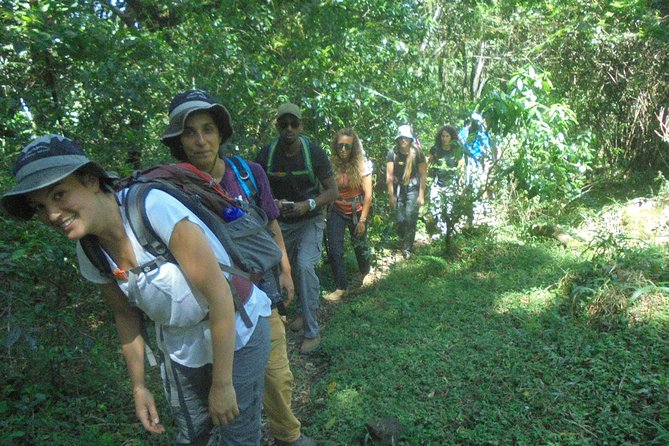
This first section covers about 10 kilometers and takes roughly four to six hours. The supplied itinerary lists the elevation range as 1,387 to 1,500 meters, although the day is also described as the approach into the mountain’s lower forest zone. The key point is that this is your gentlest day by comparison, not a flat stroll.
The armed ranger is essential here. Mount Meru rises inside Arusha National Park, and the lower route can pass through areas used by elephants, giraffes, buffalo, zebras, antelope, and monkeys. You may see wildlife, but sightings are never guaranteed. Keep your attention on the trail and follow the ranger’s directions rather than treating this section like an independent nature walk.
The forest gives the day a pleasant start. It also hides the mountain’s scale, so you may not yet feel that you are preparing for a 4,565-meter summit. That can be deceptive. Use the first day to settle into a slow pace and avoid spending all your energy looking for animals or trying to outwalk the group.
Your overnight stop is Miriakamba Hut. The huts are a practical advantage for people who prefer a roof and a designated sleeping place over camping. Still, hut accommodation is basic by nature. The supplied information does not specify room arrangements, bedding, or bathroom details, so ask the operator what to bring and what is provided before departure.
Day 2: The steep climb to Saddle Hut
Day two is shorter in distance, about 8 kilometers, but steeper. You climb from around 2,514 meters to 3,570 meters, with three to five hours of walking through forest and moorland.
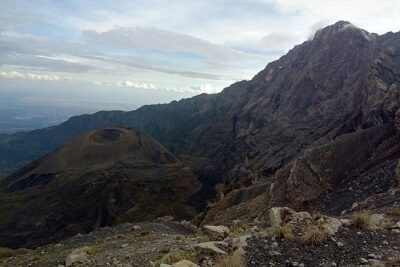
This is the day when Mount Meru begins to feel like a real mountain. The trail rises along a ridge toward Saddle Hut, and the route opens to views of the Meru Crater and the Ash Cone. The volcano’s shape becomes easier to understand as you gain height. You are no longer simply walking uphill through trees. You are moving around a huge volcanic formation.
After lunch at Saddle Hut, you can make the short climb to Little Meru at 3,820 meters. The timing is especially appealing because the viewpoint is described as a good place for sunset. This extra ascent is optional in practical terms, but it is a useful acclimatization walk and gives you a chance to test how you feel above 3,500 meters.
I would treat Little Meru as a condition check. If you feel strong, the viewpoint adds a fine reward before dinner. If you have a headache, unusual fatigue, or trouble breathing, rest and tell your guide. The following morning is much harder, so there is no prize for forcing this extra climb.
You spend the night at Saddle Hut. This is the key staging point for the summit attempt. Pack the items you need for the early start where you can reach them easily, including warm clothing, water, snacks, and a headlamp if the operator does not supply one. The provided details do not confirm equipment rental or headlamps, so do not assume those items are included.
Day 3: Rhino Point, Cobra Point, and the summit ridge
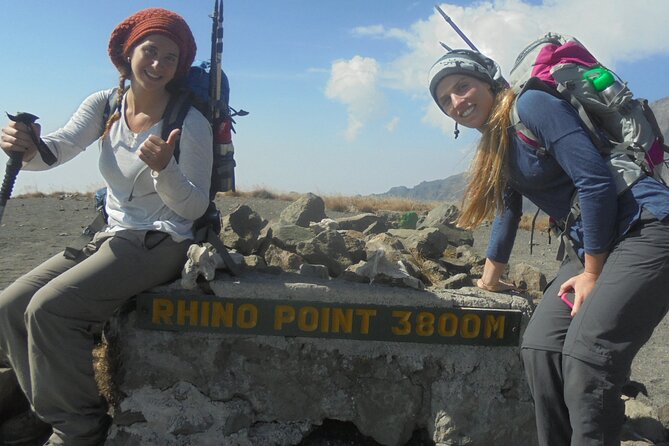
Day three is the heart of the trip. The start is around 1:30 a.m., with a steep climb to Rhino Point at approximately 3,800 meters. From there, you continue to Cobra Point at about 4,350 meters before reaching the summit around 4,565 or 4,566 meters.
The uphill distance is listed as 5 kilometers, followed by about 13 kilometers of descent. The full day takes 10 to 12 hours. That combination tells you more than the distance alone. The summit push is demanding because you climb in darkness, reach high altitude, then continue descending for most of the day.
The final ridge is the visual highlight. The route runs between the steep inner cliffs of the crater and the sloping outer wall. In places, it feels narrow and exposed. You are not simply walking to a rounded high point. You are following the edge of an immense volcanic crater with a sharp drop in the scenery below.
Reaching the summit around sunrise gives you the best light of the trip. On a clear morning, you may see Kilimanjaro rising above the clouds and look down toward the Meru Crater and Ash Cone. Weather controls the view, so treat the panorama as a bonus rather than a promise.
The most useful advice from the experience reports is to walk slowly and refuse the urge to race. One participant described the final climb as especially hard, while the guide offered small tricks that helped build confidence. Another recalled porters singing and dancing after the summit, a warm local celebration after a difficult push.
After a short rest at the top, you descend to Saddle Hut for brunch, then continue to Miriakamba Hut. This is where the day can catch up with you. The downhill walk may feel easier on your lungs, but tired legs and loose ground can make it slow and uncomfortable. Eat even if your appetite has faded, drink regularly, and tell the guide early if you are struggling.
The crew received strong praise for motivation, especially through songs and encouragement. The reports also credit the guides and porters with helping people through the steep final section. Geofrey is named in one account for delivering an excellent experience. Names and crew assignments can change, so confirm your actual guide team before you set out.
A few more options to weigh up in Arusha
- Balloon Safari & Bush Breakfast in Serengeti – Miracle Experience
★ 5.0 · 1,646 reviews - Tanzania Classic – 7 Days
★ 5.0 · 1,151 reviews - 4 Days Group Camping Safari
★ 5.0 · 1,101 reviews - 5 Days Group Camping Safari
★ 5.0 · 730 reviews
Day 4: Returning through forest and grassland
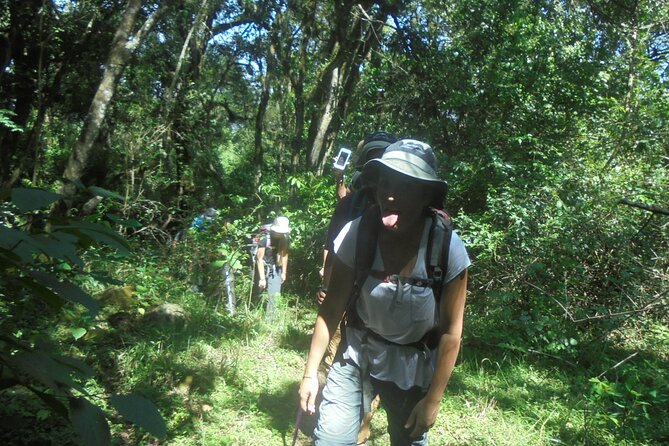
The final day covers about 10 kilometers and takes two to four hours. From Miriakamba Hut, you descend through open grassland and mixed forest toward Momela Gate.
After the long summit day, this is a welcome finish. The route is described as short and fast, with another chance to spot wildlife before leaving the park. You may see the setting in a different way now. On day one, the forest marked the beginning of a climb. On day four, it becomes the gateway back to Arusha and a hot shower.
A return transfer waits at Momela Gate to take you to your hotel in Arusha or Moshi. The listed end point is back at the meeting point, but the airport pickup and drop-off arrangement is also included in the package description. Confirm the exact transfer plan if your hotel or airport is outside the usual Arusha and Moshi area.
What the $2,600 price really covers
At $2,600 per person, this is a substantial purchase. The value depends on how much support you want and on the final handling of park charges.
The package includes airport pickup and drop-off, transport to and from the gate, crew wages, three breakfasts, three dinners, and four lunches. Those inclusions matter on a four-day mountain trip because transport, food, and staff coordination are not small extras. You are also climbing with an armed ranger, sleeping in designated huts, and using a guided route inside a national park.
The main financial warning is the park fee. Mount Meru park fees are not included and may be paid directly to the park or through the tour operator. Flights, visas, and tips for the crew are also excluded. Ask for a written total before paying so you know if the $2,600 is the complete operational cost or only the tour portion.
Tipping deserves a little planning. The porter and guide team are central to the experience, and several accounts praise their hard work and encouragement. The exact tip amount is not supplied here, so ask the operator for its current tipping guidance rather than guessing at the last minute.
The maximum group size is listed as 200 people. That is a very large possible capacity for a mountain route. The actual group may be smaller, but you should ask how many people are expected on your departure and how guides, porters, and rangers are assigned.
Food, huts, and the practical rhythm of the climb
Meals are included as three breakfasts, three dinners, and four lunches. That covers the four-day schedule in broad terms, but the information does not give menus or dietary arrangements. If you have allergies, religious requirements, or a vegetarian diet, tell the operator before the climb and ask for confirmation.
The sleeping plan uses Miriakamba Hut and Saddle Hut. You stay at Miriakamba on the first night, Saddle Hut on the second, and return to Miriakamba after the summit push. This arrangement keeps the route organized, but the return to Miriakamba on day three is also why the summit day is so long.
The permit information says Mount Meru climbing permits have a 12-hour duration time. That wording deserves clarification because the trek itself spans four days. Ask the operator how the permit timing applies to your climb and whether the permit is arranged for each required period.
Who should book this Mount Meru route?
I would recommend it to you if you want:
- A serious but shorter mountain climb before Kilimanjaro
- A route with crater views and a narrow summit ridge
- A chance to see wildlife in a national park
- Hut accommodation rather than tent camping
- A guided experience with an armed ranger
- A demanding personal challenge supported by guides, cooks, and porters
I would hesitate if you want a relaxed hiking holiday. The 1:30 a.m. start, high altitude, steep summit route, and 10 to 12-hour third day require real preparation. The price is also hard to judge until you confirm the park fees and the actual group size.
The best preparation is not speed training. Practice steady uphill walking, long descents, and carrying the daypack you will use on the mountain. Break in your boots, learn to layer clothing, and get used to eating and drinking while walking. Most importantly, arrive ready to follow a slow pace.
Booking details and cancellation terms
Confirmation is provided at booking, and most people can participate according to the supplied information. Pickup is offered, and the tour uses a mobile ticket.
You can cancel up to 24 hours before the local start time for a full refund. Cancellations or changes made within 24 hours are not accepted for a refund. The climb depends on good weather, and if poor weather causes cancellation, you are offered another date or a full refund.
Should you book the four-day Mount Meru climb?
Book it if you want a proper mountain test, not merely a scenic walk. The combination of wildlife, crater scenery, hut nights, and a sunrise summit gives Mount Meru a character of its own. It is not just a cheaper Kilimanjaro rehearsal.
I would book after confirming three things in writing: the total price including park fees, the expected group size, and exactly what equipment and hut services are provided. If those details suit you and you can handle the summit day, this is a strong choice for a fit hiker who wants Tanzania’s quieter high mountain before tackling Kilimanjaro.
FAQ
Where does the Mount Meru climb take place?
The climb takes place in and around Arusha National Park near Arusha, Tanzania. The route begins at Momela Gate and reaches Mount Meru’s summit at about 4,565 to 4,566 meters.
How long is the Mount Meru tour?
The tour lasts approximately four days. Walking times range from two to four hours on day four and up to 10 to 12 hours on the summit day.
What time does the tour start?
The listed start time is 8:30 a.m. at Arusha Center Inn TouristTZ on Main Street, Bondeni Street, in Arusha. Day three has a separate early summit start at around 1:30 a.m.
Is an armed ranger required?
Yes. Because Mount Meru is within Arusha National Park and wildlife lives along the route, hikers climb with an armed ranger escort.
Where do you sleep during the climb?
You sleep in designated mountain huts. The itinerary names Miriakamba Hut and Saddle Hut as the overnight locations.
Is wildlife viewing included?
Wildlife viewing is part of the route’s setting, and you may see elephants, giraffes, buffalo, zebras, monkeys, or antelope, especially on the lower slopes. Sightings are not guaranteed.
Are meals included?
Yes. The package includes three breakfasts, three dinners, and four lunches.
Are park fees included in the price?
No. Mount Meru park fees are excluded and may be paid directly to the park or through the tour operator. Flights, visas, and crew tips are also not included.
Just added in Arusha
- Safari “Kifaru” – 5 days in the most famous Parks in the world★ 5.0 · 4 reviews
- Saadani Day Trip★ 5.0 · 13 reviews
- 3 Days Tanzania Short and Spicy★ 5.0 · 6 reviews
- 5 Day Tanzania Safari Camping Adventure Private Tour★ 5.0 · 2 reviews
- Day Trip to Ngorongoro Crater from Arusha★ 5.0 · 1 review
- SERENGETI NATIONAL PARK Tour★ 4.5 · 5 reviews
- 3 Days Serengeti Park & Ngorongoro Crater Adventure Safari★ 5.0 · 8 reviews
- 6 Days Tanzania Bush Experience Safari★ 5.0 · 6 reviews
Hiking & Trekking, compared.
8-Day Small-group Lemosho Kilimanjaro Summit Trekking
Read our review →
Private Full Day Hiking Experience to Marangu Route
Read our review →
From Arusha/Moshi: Kilimanjaro Hike Marangu Route Day Trip
Read our review →
4 days Best experience Kilimanjaro Hike, Serengeti &Ngorongoro
Read our review →
Best Kilimanjaro hiking day trip tour with Kilinge Adventures
Read our review →Browse the lists this tour appears in