Reviewed · ARUSHA TOURS
5 Days_Haking_Mount_Kilimanjaro by_Using_Marangu Route
Africa’s highest summit starts with a forest walk. This five-day Marangu Route climb gives you a clear path to Uhuru Peak, hut beds instead of tents, and meals served in shared dining huts. I especially like the solar-lit mountain huts and the chance to see Colobus monkeys, giant lobelias, Mawenzi, and Kibo along the way. The route is also the shortest standard way up Kilimanjaro, which helps keep the price at $1,809.50 per person within reach for a guided summit trip.
The main drawback is the tight schedule. You gain altitude quickly, sleep at Kibo, and begin the summit push around 2:00 a.m. The route is called the Coca Cola route for good reason: it is direct and popular, but it gives you less time to adjust than a longer climb. An extra night at Horombo can make the experience gentler, but this five-day package does not include that added acclimatization day.
In This Review
- Key Points Before You Book
- Why Choose Marangu for Kilimanjaro?
- Day One: Marangu Gate to Mandara Hut
- Day Two: The Moorland Walk to Horombo
- Day Three: Kibo Hut and the Moonscape
- Day Four: The Summit Push to Uhuru Peak
- Day Five: Down Through the Forest to Moshi
- What the $1,809.50 Price Covers
- Food, Water, Huts, and Daily Comfort
- Who Will Like This Climb Most?
- Booking Details and Cancellation
- Should You Book the Five-Day Marangu Route?
- FAQ
- How long is the Kilimanjaro Marangu Route experience?
- Where does the climb begin?
- Where do I sleep during the climb?
- Is running water available at the huts?
- Is the summit climb included in the price?
- Are meals and drinking water included?
- What is not included?
- Can I cancel for a full refund?
Key Points Before You Book
- Hut sleeping at every camp: You sleep in communal huts with bunk beds, sponge mattresses, pillows, and solar lights.
- A 2:00 a.m. summit start: The climb to Gilman’s Point and Uhuru Peak is the hardest part of the trip.
- Maundi Crater side trip: On the first day, this short detour offers views toward northern Tanzania and Kenya.
- Fast altitude gain: You move from rainforest to high moorland, alpine desert, and the summit in only a few days.
- Meals and water included: Breakfast, lunch, dinner, and clean purified drinking water are part of the package.
- Private group format: Only your own group takes part, with pickup offered and arrival and departure transfers included.
Why Choose Marangu for Kilimanjaro?
Marangu is the most straightforward route on Kilimanjaro. You walk on a defined trail and sleep in huts at Mandara, Horombo, and Kibo instead of carrying or sleeping in a tent. That makes a real difference after a long day on your feet.
The huts are communal, so you should expect shared sleeping rooms rather than private cabins. Mandara and Kibo each have 60 beds, while Horombo has 120. Bunks come with a sponge mattress and pillow, and solar lights provide basic illumination. You will not be roughing it in total darkness, but this is still a mountain camp, not a hotel.
The social side is part of the appeal. Groups from different countries share meals in dining huts, creating a lively setting at the end of each day. Soft drinks, bottled water, and beer may be sold at the huts, with prices rising as you climb. Bring small Tanzanian bills if you want to buy anything along the route.
I would choose Marangu if you value simple logistics, hut accommodation, and a shorter route. I would think twice if you want a quieter trail or more time for altitude adjustment. The route is popular, and its five-day schedule is demanding despite its friendly nickname.
A few more options to weigh up in Arusha
- Balloon Safari & Bush Breakfast in Serengeti – Miracle Experience
★ 5.0 · 1,646 reviews - Tanzania Classic – 7 Days
★ 5.0 · 1,151 reviews - 4 Days Group Camping Safari
★ 5.0 · 1,101 reviews
Day One: Marangu Gate to Mandara Hut
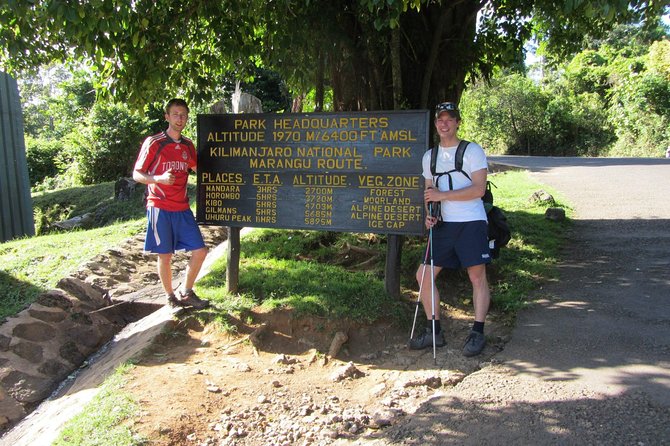
After breakfast and a briefing, you drive for about 45 minutes to the Kilimanjaro park gate. Registration comes first. Then you begin walking through the forest toward Mandara Hut, which sits at about 9,000 feet, or 2,740 meters.
This is the easiest-looking day, but do not treat it as a casual stroll. The rainforest can be damp, and the trail gains height steadily. You might see tall Eucalyptus trees, birds, and Colobus monkeys among the trees. The change from ordinary farmland and roads to thick mountain forest happens quickly.
The Maundi Crater side trip is a worthwhile option if your energy and schedule allow it. From there, you can look across northern Tanzania and toward Kenya. It is a small addition to the day, but it gives you a better sense of where you are than simply walking straight to the hut.
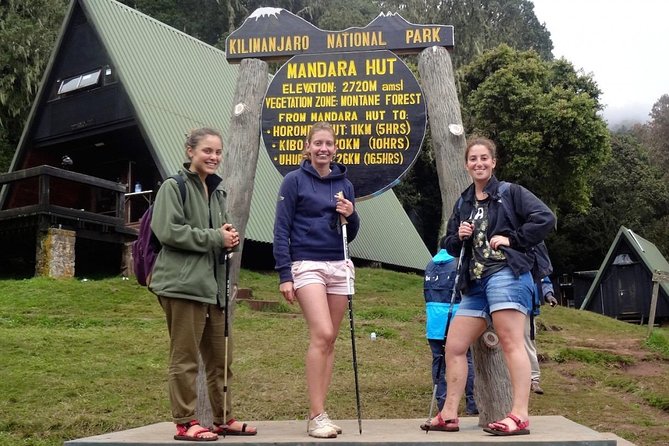
Mandara has beds for 60 people, solar lighting, and shared facilities. This is also where the communal nature of the route becomes clear. You may be sleeping near people from several countries, so earplugs can be useful even though they are not listed among the tour supplies.
Your first night is less about comfort than settling into the rhythm of mountain walking. Eat well, drink the supplied purified water, and keep your rain gear handy. The forest can feel cool and wet even when the lower elevations around Arusha are warm.
Day Two: The Moorland Walk to Horombo
Day two takes you out of the rainforest and into open moorland. The trail climbs toward Horombo Hut, with the peaks of Mawenzi and Kibo appearing as the trees thin out.
The stated walking time is about five hours. You will begin to notice the altitude here, especially if you are not used to walking above 2,700 meters. Move slowly and keep your breathing steady. The point is not to win the morning.
Giant lobelias and groundsels add an odd, almost prehistoric look to the route. The vegetation is low and open, so you gain wide views instead of the enclosed feeling of the forest. Mawenzi is especially striking, with its jagged profile contrasting with the smoother bulk of Kibo.
Horombo is the largest hut camp on this route, with 120 beds. Bathrooms and running water are available at the two lower huts, including Horombo. That makes this your last relatively comfortable camp before the upper mountain.
The schedule allows an important choice here. You can spend an extra day resting at Horombo or walking toward the smaller peak of Mawenzi. That extra day is not part of the listed five-day plan, but it is the most useful adjustment if altitude worries you. The shorter schedule saves time and money, yet the tradeoff is a faster climb.
Day Three: Kibo Hut and the Moonscape
From Horombo, you continue toward Kibo Hut. The walk takes about six hours and crosses the broad saddle between Mawenzi and Kibo.
At first, you pass through upper heathland. Then the plant life fades away and the surroundings become bare, gray, and stark. This is the mountain’s high alpine desert, often described as a moonscape. The change is dramatic, and it also reminds you that water and warmth become more important with every step.
Kibo is the final camp before the summit. It has 60 beds, but its facilities are basic. The lower huts have running water, while the latrines at the last camp are very simple. Plan for a less comfortable night and organize your clothing, headlamp, gloves, water, and snacks before trying to sleep.
Dinner comes before rest, but sleep can be difficult. You are high, excited, and aware that the summit attempt begins around 2:00 a.m. The best approach is to keep the evening quiet and prepare everything in advance.
The package includes meals and purified drinking water, which removes some packing pressure. Still, bring personal snacks if you rely on familiar foods during strenuous exercise. Drinks sold at the huts cost more at higher elevations, so small Tanzanian notes are handy.
A different kind of day out entirely:
- 5 Days Group Camping Safari
★ 5.0 · 730 reviews - Materuni Waterfalls, coffee tour & Kikuletwa Hot Springs
★ 5.0 · 643 reviews - 3 Days Serengeti & Ngorongoro Group Camping Safari
★ 5.0 · 574 reviews - 7-Day Premium Luxury Tanzania Safari All-Inclusive
★ 5.0 · 426 reviews
Day Four: The Summit Push to Uhuru Peak
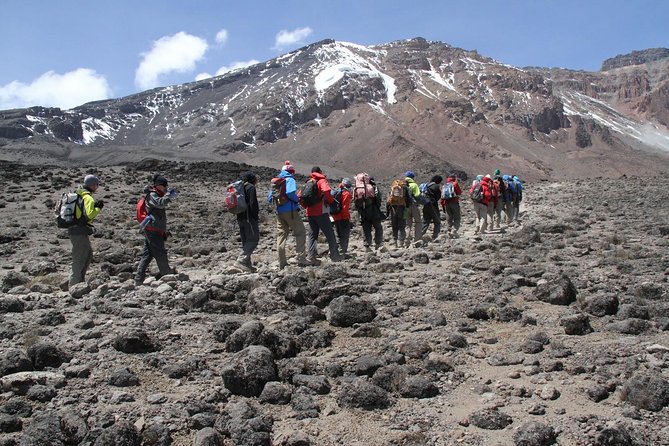
Summit day is the reason you are here, and it is also the day that tests the five-day schedule.
You leave Kibo around 2:00 a.m. and climb steep scree or snow toward Gilman’s Point. The ascent is described as taking four to seven hours, depending on conditions and your pace. Scree is loose, tiring ground, so trekking poles can help you stay steady.
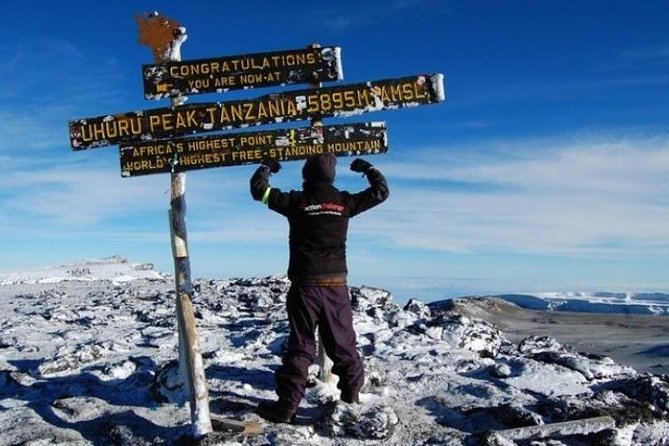
Gilman’s Point sits on the crater rim at about 18,640 feet, or 5,861 meters. Reaching it is a major achievement, but you still have another one to two hours to Uhuru Peak. At 19,340 feet, or 5,895 meters, Uhuru is the highest point in Africa.
The cold, darkness, thin air, and steep footing all arrive at once. This is where patience matters. You may feel strong at the start and very slow later. Follow your guide’s pace, take small steps, and do not judge the day by how quickly other climbers move.
The reward is a broad view from the summit, with the crater and distant terrain opening around you. You will have time to take a summit photograph before beginning the descent. That photo will be useful proof when friends politely ask if you really made it.
After reaching Uhuru, you descend to Kibo for lunch and a rest, then continue down to Horombo for dinner and the night. The listed walking time is six hours, but summit day includes a very early start, a steep ascent, the summit section, and a long descent. You should think of it as the most demanding day of the trip, not merely another six-hour walk.
This is also where the support team matters most. The company’s guides receive strong praise for patience, good humor, and positive support. Gabriel is specifically associated with a summit hike, while Rafael is praised for his kindness and the way his team cared for the group. Those personal touches can help when the trail becomes a battle of small steps.
Day Five: Down Through the Forest to Moshi
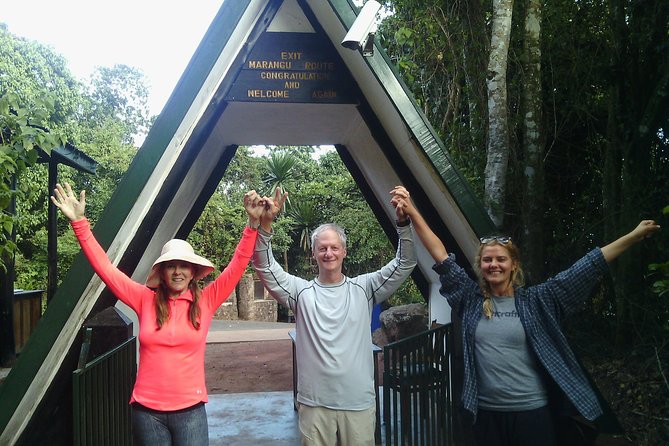
The final day begins with breakfast and a steady descent from Horombo toward Mandara Hut. You return through the moorland and then re-enter the forest.
The trail to Marangu Gate is described as good, but lower elevations can be wet and muddy. Gaiters and trekking poles are useful here. Keep rain gear and warmer clothing in your daypack even if the morning begins dry. By the time you reach the lower forest, shorts and a T-shirt may be enough, but mountain weather can change quickly.
The descent to the national park gate is about five hours. From Marangu village, a vehicle takes you back to your hotel in Moshi or Arusha. That transfer is included, as are arrival and departure transfers connected with the package.
The end of the walk is a good time to thank the guides and porters directly. Tips are not included, so set aside cash for them. A celebration meal or drink back in town will feel well earned after five days of climbing and descending.
What the $1,809.50 Price Covers
At $1,809.50 per person, this is not a budget day hike. It is also more than a simple trail fee, because the price covers the main operating costs of a guided Kilimanjaro climb.
Included services are:
- Kilimanjaro park fees
- Rescue fees
- Professional mountain guides
- Arrival and departure transfers
- Pickup service
- Breakfast, lunch, and dinner
- Clean, purified drinking water
- Two nights of hotel accommodation
- Hut accommodation during the mountain section
The package information lists five breakfasts, five lunches, and five dinners, along with two hotel nights. Since the mountain itinerary includes communal huts and a return to Moshi or Arusha, check the exact hotel-night arrangement before paying if that detail matters to you.
The value is strongest if you want one company to handle permits, transfers, guides, food, and mountain support. You still need to budget for tips, international flights, personal gear, drinks bought at the huts, and any extra night at Horombo.
A private group is another useful part of the price. Only your group takes part, so you are not automatically attached to a large public departure. The group size itself is not stated, so ask how many people will be in your party and how many guides or porters will support it.
Food, Water, Huts, and Daily Comfort
The tour includes nutritious meals and clean purified drinking water. That is important on Kilimanjaro, where a lack of food or fluids can make a hard day much harder.
Meals are served in dining huts shared by climbing groups. You should expect a social setting rather than a private table. The communal arrangement adds energy to the evenings, but it also means noise and activity around meal times.
Hut beds have sponge mattresses and pillows, which is a welcome step above sleeping directly on the ground. Solar lights are available, but you should still carry a headlamp because lighting at a mountain camp is basic.
Bathrooms are more usable at Mandara and Horombo, where running water is available. At Kibo, the latrines are very basic. That is one of the clearest comfort compromises on this route, and it is worth accepting before you book rather than discovering it when you are already exhausted.
Who Will Like This Climb Most?
I would recommend this experience to someone with moderate physical fitness who wants to attempt Kilimanjaro without camping. You need to handle several hours of uphill walking, cold conditions, a pre-dawn summit start, and a long descent.
It suits you if:
- You prefer huts to tents.
- You want a shorter route to Uhuru Peak.
- You value included transfers, meals, park fees, and guides.
- You like meeting other climbing groups at shared meals.
- You can manage a fast altitude schedule.
- You want a private group rather than a shared booking.
I would be more cautious if you have never done sustained mountain walking or if you know you need extra time at altitude. The possibility of adding a rest day at Horombo is useful, but you must confirm the cost and schedule because it is not part of the standard five-day plan.
The experience also suits people who value friendly support. The team receives particularly warm praise for service, patience, humor, food, and encouragement. Names connected with the operation include Gabriel, Rafael, and Mary, who is described as providing a warm airport welcome. Ask in advance which guide will lead your group.
Booking Details and Cancellation
Confirmation is provided at booking, and pickup is offered. This is a private tour and activity, with only your group participating.
Free cancellation applies if you cancel at least 24 hours before the local start time. Cancellations within 24 hours are not refunded, and changes inside that period are not accepted. International flights are not included.
Should You Book the Five-Day Marangu Route?
Book it if you want the simplest hut-based route to Kilimanjaro and you accept a brisk altitude schedule. The included park and rescue fees, meals, water, transfers, hotel accommodation, and professional guides give the price real substance.
I would try to add a Horombo acclimatization day if your schedule and budget allow. If you cannot add time, prepare carefully, walk slowly, and treat the summit morning as a serious physical effort.
This is a good choice for a fit first-time climber who wants structure, warm meals, a bed each night, and a direct route to Africa’s highest point. It is less suitable for anyone seeking solitude, a relaxed pace, or soft facilities at every camp.
FAQ
How long is the Kilimanjaro Marangu Route experience?
The experience lasts approximately five days.
Where does the climb begin?
After breakfast and a briefing, you drive about 45 minutes from the Arusha area to the Kilimanjaro park gate, where you register and begin walking.
Where do I sleep during the climb?
You sleep in communal huts at Mandara, Horombo, and Kibo. The huts have bunk beds, sponge mattresses, pillows, and solar lights.
Is running water available at the huts?
Bathrooms and running water are available at the two lower huts. Facilities at the last camp, Kibo, are very basic.
Is the summit climb included in the price?
Yes. The route includes the climb to Gilman’s Point and onward to Uhuru Peak, the highest point in Africa.
Are meals and drinking water included?
Yes. The package includes breakfast, lunch, dinner, and clean purified drinking water.
What is not included?
Tips and international flights are not included. Drinks purchased at the huts may also cost extra.
Can I cancel for a full refund?
Yes, if you cancel at least 24 hours before the experience’s local start time. Cancellations within 24 hours are not refunded.
Just added in Arusha
- Safari “Kifaru” – 5 days in the most famous Parks in the world★ 5.0 · 4 reviews
- Saadani Day Trip★ 5.0 · 13 reviews
- 3 Days Tanzania Short and Spicy★ 5.0 · 6 reviews
- 5 Day Tanzania Safari Camping Adventure Private Tour★ 5.0 · 2 reviews
- Day Trip to Ngorongoro Crater from Arusha★ 5.0 · 1 review
- SERENGETI NATIONAL PARK Tour★ 4.5 · 5 reviews
- 3 Days Serengeti Park & Ngorongoro Crater Adventure Safari★ 5.0 · 8 reviews
- 6 Days Tanzania Bush Experience Safari★ 5.0 · 6 reviews
Arusha Tours, compared.
Balloon Safari & Bush Breakfast in Serengeti – Miracle Experience
Read our review →
Materuni Waterfalls, coffee tour & Kikuletwa Hot Springs
Read our review →
3 Days Serengeti & Ngorongoro Group Camping Safari
Read our review →
7-Day Premium Luxury Tanzania Safari All-Inclusive
Read our review →