
Reviewed · MACHAME ROUTE CLIMBS
6 Days Machame Route Kilimanjaro Trekking
Africa’s highest peak demands respect. This six-day Machame Route trek gives you Kilimanjaro’s best mix of forest, moorland, volcanic rock, and high alpine terrain without the cost of a longer circuit. I like the changing habitats and wide mountain views, and I also like that the package covers the major expenses: park fees, rescue fees, porters, camping gear, meals, and a professional guide.
The main concern is the schedule. Six days is a brisk version of this climb, with a long summit push and limited time for your body to adjust to altitude. If you walk slowly or prefer a gentler pace, the seven-day version may suit you better. The tour is private, so your group can receive close attention from guides such as Matthew, Joshua, Oliver, or Benjamin, depending on availability.
In This Review
- Key points to know before booking
- Why Machame is Kilimanjaro’s popular route
- Day 1: Moshi to Machame Camp, 5,400 to 9,400 feet
- Day 2: Machame Camp to Shira Camp, 9,400 to 12,500 feet
- Day 3: Shira Plateau to Lava Tower and Barranco Camp
- Day 4: Barranco Wall to Barafu Camp
- Day 5: Summit night, Stella Point, Uhuru Peak, and descent
- Day 6: Mweka Camp to the park gate
- What the $1,930.42 price really covers
- The guide and porter team
- Who should choose the six-day version?
- Practical preparation for the six days
- Should you book this Machame Route trek?
- FAQ
- Where does the trek start and end?
- How long is each day of hiking?
- What habitats will I pass through?
- Are meals included?
- Is camping equipment provided?
- Can I rent climbing gear?
Key points to know before booking
- Machame offers changing scenery: You move from rainforest to moorland, semi-desert, alpine desert, and Arctic conditions.
- Day three helps with acclimatization: You climb toward Lava Tower, reaching about 16,000 feet before sleeping lower at Barranco Camp.
- Summit night starts around midnight: The ascent to Stella Point and Uhuru Peak is cold, dark, steep, and physically demanding.
- The package covers the major climbing costs: Camping equipment, food, park charges, rescue fees, guides, and porters are included.
- You need to budget for extras: Flights, lodging before and after the trek, sleeping bag rental, climbing gear rental, insurance, visa fees, towels, and tips are not included.
- The company has a strong service record: The most praised points are attentive guides, good English communication, helpful porters, solid food, and careful support on summit day.
Why Machame is Kilimanjaro’s popular route
The Machame Route is often called the Whisky Route, a nickname that hints at its tougher character compared with the easier Marangu approach. It is popular because it gives you more scenery and a better sense of Kilimanjaro’s changing plant zones.
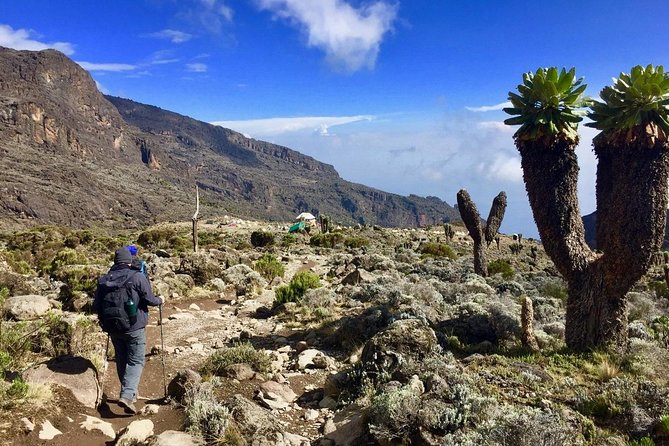
The route begins in thick rainforest. Higher up, trees give way to heather and open moorland. Then the ground becomes dry and rocky, with volcanic formations and broad views across the mountain. Near the top, plants disappear almost completely, leaving only scree, ice, rock, and sky.
About half of Kilimanjaro climbers are said to choose Machame, including many experienced climbers. Its popularity also comes from practical matters. Access from Moshi is straightforward, and the six-day version costs less than longer routes.
That lower price has a tradeoff. You gain a shorter itinerary, but you lose an extra day for altitude adjustment. Kilimanjaro is not a technical climb, yet altitude can affect people who are fit, experienced, and otherwise healthy. The pace matters. You will need to walk slowly, listen to your guide, drink regularly, and accept that summit success depends on more than leg strength.
More Machame Route climbs:
- 7 Days Kilimanjaro via Machame route affordable price
★ 5.0 · 110 reviews - 6 Days Climbing Mount Kilimanjaro Machame Route
★ 5.0 · 40 reviews - 7-Day Machame Route Kilimajaro
★ 5.0 · 28 reviews
Day 1: Moshi to Machame Camp, 5,400 to 9,400 feet
The drive from Moshi to Kilimanjaro National Park Gate takes about 50 minutes. The road passes through Machame village on the lower slopes of the mountain, then reaches the park entrance, where the climb begins.
The first day covers about 11 kilometers and takes five to seven hours. You walk through rainforest on a winding trail that climbs along a ridge. This is a beautiful start, but it can also be wet, muddy, and slippery, especially lower down.
Pack your gaiters and trekking poles where you can reach them. Do not bury them at the bottom of your bag. The trail is not a gentle stroll, and rain can turn sections into a messy test of balance.
The forest is the first reminder that Kilimanjaro is not just a summit challenge. The air is humid, the trail is shaded, and the vegetation feels far removed from the dry volcanic slopes you will see later.
You finish at Machame Camp around 9,400 feet. The day is long enough to make you hungry, but it is not the hardest section of the trek. Use the evening to eat well, organize your sleeping gear, and prepare for a cooler night.
Day 2: Machame Camp to Shira Camp, 9,400 to 12,500 feet
After breakfast, the route leaves the rainforest behind. The trail climbs through heather and moorland, crossing a small valley before following a steep, rocky ridge.
This is a shorter day by distance, only about five kilometers, but the climb is steady. Expect four to six hours of walking. The change in scenery is the reward. Trees become smaller and less common, and the mountain begins to feel more open and exposed.
The trail eventually turns west toward a river gorge, where you reach Shira Camp. At about 12,500 feet, this is a useful early test of how your body handles altitude.
You may feel fine at this point, or you may notice a headache, poor sleep, or less appetite. Do not try to prove anything. Tell your guide how you feel. The guides are there to monitor your pace and condition, not simply to lead you from one camp to the next.
Shira is also where the route begins to offer larger views. The forest is now below you, and the high mountain begins to dominate the horizon. Even so, the weather can shift quickly, so keep warm layers and rain protection handy.
Day 3: Shira Plateau to Lava Tower and Barranco Camp
Day three is one of the most important days on the route. You walk about 10 kilometers for six to eight hours, starting at roughly 12,500 feet and reaching around 13,000 feet by the time you settle at Barranco Camp.
The route crosses the Shira Plateau and continues east along a ridge. It passes a junction toward Kibo, the main summit cone, before turning southeast toward Lava Tower, also described as the Shark’s Tooth.
The itinerary includes the junction toward Arrow Glacier at about 16,000 feet. You then descend to Barranco Hut at approximately 13,000 feet. This climb high, sleep lower pattern is valuable because it gives your body time to adjust without leaving you to sleep at the day’s highest point.
It is a demanding day, but not because you gain a huge net amount of altitude. The repeated climbing and descending can tire your legs, and the dry semi-desert environment provides little shade.
Barranco Camp is memorable for its dramatic setting beneath the Barranco Wall. The mountain feels more rugged here, with dark rock, open slopes, and a stronger sense that the summit is still a serious distance away.
Eat dinner, drink, and sleep as much as you can. Day three is where good pacing begins to matter more than speed.
More treks in Kilimanjaro:
- 8 Days Kilimanjaro Hike via Lemosho Route
★ 5.0 · 39 reviews - 6 Days Marangu Route Trekking
★ 5.0 · 2 reviews - 8-Day Small-group Lemosho Kilimanjaro Summit Trekking
★ 5.0 · 186 reviews - Mountain Kilimanjaro Day Hike
★ 5.0 · 102 reviews
Day 4: Barranco Wall to Barafu Camp
Day four covers about nine kilometers and takes eight to 10 hours. You begin at Barranco Camp, climb past the Barranco Wall, continue through Karanga Valley, and then head toward Barafu Hut at about 15,300 feet.
The Barranco Wall is steep and can look intimidating from camp. The route is not described as technical climbing, but you should expect hands-on movement in places and a slow, careful ascent. Your guide’s support matters here, especially if you dislike exposed or awkward sections.
From Barranco, the trail reaches Karanga Valley before joining the junction connected with the Mweka Trail. You then continue upward to Barafu Camp.
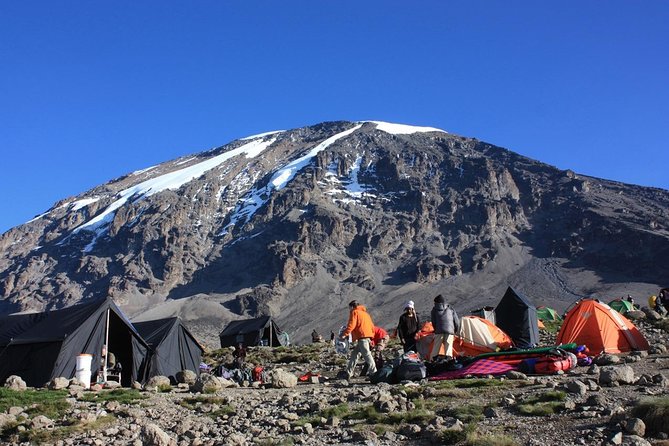
At Barafu, you have completed the South Circuit. The route has provided views of the summit from several angles, and the two major peaks, Mawenzi and Kibo, can be seen from this position.
Barafu is not a place for a relaxed evening. You will eat, rest, organize clothing, and prepare for the midnight or 2 a.m. summit start. Keep your headlamp, gloves, warm layers, water, and snacks ready. You do not want to sort through your duffel while half asleep and already cold.
This is also the point where the six-day schedule shows its limits. You have gained altitude quickly over four days. The support of a private guide team can help, but no guide can remove the physical demands of the mountain.
Day 5: Summit night, Stella Point, Uhuru Peak, and descent
Summit day is the heart of the trip and the hardest part by far. The ascent begins between midnight and 2 a.m., when the mountain is dark and temperatures are low.
The route climbs through heavy scree between the Rebmann and Ratzel glaciers, heading toward Stella Point on the crater rim at about 18,600 feet. The ascent is only about five kilometers, but it takes seven to eight hours because the air is thin, the slope is steep, and every step requires effort.
This is the section where a slow pace is essential. Guides who keep you moving carefully, check on you, and adjust the pace to your condition can make a real difference. The strongest service praise connected with this tour centers on exactly that kind of care. Specific guides named in past groups include Matthew, Joshua, Oliver, and Benjamin, with comments highlighting patience, personal attention, clear English, and hands-on help.
At Stella Point, you can rest briefly and, weather permitting, watch sunrise. This is often the emotional high point of the climb, even before reaching Uhuru Peak.
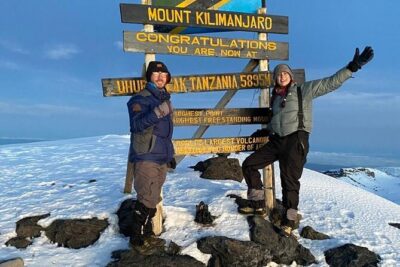
The itinerary lists the summit at 19,345 feet. From Stella Point, the route continues along the crater rim toward Uhuru Peak. Reaching the top is not guaranteed, and you should treat the summit as a goal rather than a promise. Altitude, weather, exhaustion, and individual health all matter.
After the summit, you descend toward the lower Mweka area, reaching about 10,000 feet. The descent is long, with about 12 kilometers listed after the ascent. Scree can be hard on tired knees, and the total day may feel closer to an endurance event than a normal hike.
Bring trekking poles if you use them. They are useful during both the climb and the long descent. You should also keep rain gear and warmer clothing available because conditions can change before you reach camp.
Day 6: Mweka Camp to the park gate
The final day is much shorter, with about 10 kilometers of descent taking three to four hours. You walk from around 10,000 feet down to the Mweka Park Gate at roughly 5,400 feet.
The route returns to rainforest, and the temperature rises as you lose altitude. Lower sections can be wet and muddy, so keep your gaiters and poles ready until the walk is finished. Shorts and a T-shirt may be comfortable near the bottom, but keep rain gear and a warm layer in your daypack.
At the Mweka Gate, you receive your summit certificates. This is also the point where the trek officially ends and the activity returns to the meeting point.
The listing gives Kilimanjaro International Airport as the starting and ending meeting point, and pickup is offered. Confirm the exact transfer plan before you arrive, especially if you are staying in Moshi before or after the climb. Lodging outside the trek is not included.
What the $1,930.42 price really covers
At $1,930.42 per person, this is not a budget walk in the ordinary sense, but it includes many costs that can add up quickly on Kilimanjaro.
The package includes:
- All accommodation during the trek
- Camping equipment, including a mess tent, mattress, and cooking equipment
- Park charges and parking fees
- Rescue fees
- Professional driver and guide
- Porters
- Five breakfasts, five lunches, and five dinners
- Taxes and VAT
The porters and cooking team are especially important on a camping route. You are not carrying the full camp or cooking your own meals after a long day. Past groups have praised the food, facilities, and porter support, which adds real value to the price.
You still need to budget for international flights, accommodation before and after the trek, sleeping bag rental, climbing gear rental, bath towels, travel insurance, visa fees, personal purchases, possible government tax or park-fee increases, and tips.
Climbing gear and sleeping bags are available to rent, but the price is not given here. Ask for the current rental rates and equipment list before paying. Also ask what size of personal bag the porters will carry and what you should keep in your small daypack.
The guide and porter team
The strongest part of this experience is the human support. Past groups repeatedly praise the guides’ English, communication, patience, and willingness to help. Guides named in the feedback include Erastus, Matthew, Joshua, Oliver, and Benjamin.
Erastus appears to handle coordination as well as trip arrangements, including preparation before and after the trek. Several comments also praise the company’s ability to manage details with a calm, friendly attitude.
That matters on Kilimanjaro. You will spend long hours walking, then face cold nights, basic camp conditions, and an early summit start. A guide who notices when you need a slower pace or extra help can shape the entire experience.
The private format is another benefit. Only your group participates, so the pace and support can be more personal than on a large shared departure. Still, group size is not specified, so ask how many climbers, guides, and porters will be assigned to your booking.
Who should choose the six-day version?
I would recommend this itinerary to a fit hiker who wants a shorter, more affordable Machame climb and understands that the schedule is demanding.
It may suit you if:
- You are comfortable walking for five to 10 hours a day.
- You can handle a midnight summit start.
- You prefer varied scenery to the shortest possible approach.
- You value a private group and close guide support.
- You are willing to walk slowly and follow altitude advice.
I would think twice if you want a relaxed mountain holiday. One past climber specifically suggested seven days for people who walk slowly. That is sensible advice. An extra day can make the climb less compressed and may give your body more time to adjust.
This is also not the right choice if you expect hotel comfort on the mountain. The included accommodation is camping, and the package does not include bath towels. You should prepare for basic facilities and changing weather.
Practical preparation for the six days
Keep your clothing system flexible. The route moves from warm, wet forest to cold Arctic conditions near the summit, so you need both rain protection and substantial warm layers.
Pack gaiters and trekking poles. The itinerary specifically warns about mud on the first and final days, and poles can help on steep or loose ground.
Prepare for the summit day more than any other section. Your warmest clothing, headlamp, gloves, snacks, water, and required gear should be ready before dinner at Barafu. You will not want to waste energy searching through luggage at 1 a.m.
Also plan for tips, insurance, visas, and lodging outside the trek. Since the activity is non-refundable and cannot be amended after booking, confirm your dates, airport arrangements, gear needs, and accommodation plans before you pay.
Should you book this Machame Route trek?
I would book it if you want Kilimanjaro’s classic scenery, a private team, and a package that covers the major mountain costs. The praise for guides, food, porters, and personal support is consistent, and the route gives you a strong variety of habitats in only six days.
I would choose seven days instead if you are a slower walker, have limited high-altitude experience, or want more breathing room. The six-day Machame Route is a real challenge, not a casual sightseeing tour. Go in with realistic expectations, use the guides’ pace, and budget for the extras that are not covered.
FAQ
Where does the trek start and end?
The listed meeting point is Kilimanjaro International Airport on Kilimanjaro Airport Road, Tanzania. The activity ends back at the meeting point, and pickup is offered.
How long is each day of hiking?
Daily hiking times range from three to four hours on the final descent to eight to 10 hours on day four. Summit day includes seven to eight hours of ascent and four to six hours of descent.
What habitats will I pass through?
You pass through rainforest, moorland, semi-desert, alpine desert, and Arctic terrain. The first and final days are in rainforest, while the summit section is Arctic.
Are meals included?
Yes. The package includes five breakfasts, five lunches, and five dinners.
Is camping equipment provided?
Yes. The package includes a mess tent, mattress, and cooking equipment, along with accommodation during the trek. Sleeping bags are not included but are available to rent.
Can I rent climbing gear?
Yes. Climbing gear is available for rent, although the current rental cost is not provided. Ask for the equipment list and rates before booking.
Just added in Kilimanjaro
- Tanzania Wildlife Encounters – 6 Days★ 5.0 · 1 review
- Day Trip To Tarangire National Park★ 4.5 · 2 reviews
- Mount Kilimanjaro 7 Days – Machame Route★ 5.0 · 5 reviews
- 5 days Serengeti Wildebeest Migration Safari★ 5.0 · 3 reviews
- Mount Kilimanjaro 6 days – Machame route★ 4.0 · 5 reviews
- Marangu Cultural tour.★ 5.0 · 1 review
- Lemosho Route★ 5.0 · 21 reviews
- Airport Transfers at Kilimanjaro International Airport – JRO★ 5.0 · 2 reviews
Machame Route Climbs, compared.

Climbing Kilimanjaro through 7 days Machame Route
Read our review →
7-Day Machame Kilimanjaro Summit Tour from Arusha
Read our review →
7 Days Kilimanjaro via Machame route affordable price
Read our review →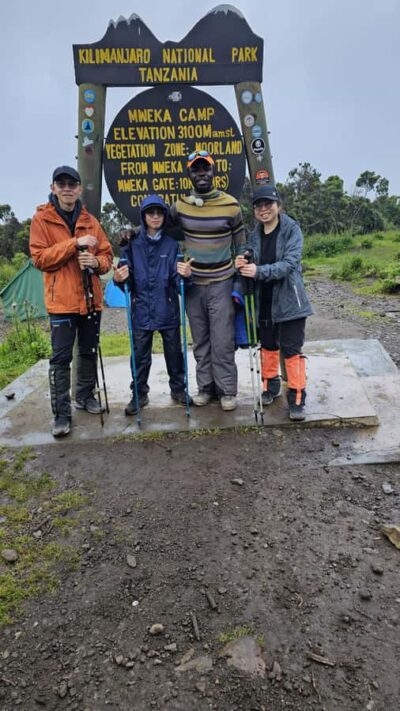
#1. Best Kilimanjaro Day hike Tour-Machame Route-ISMANI
Read our review →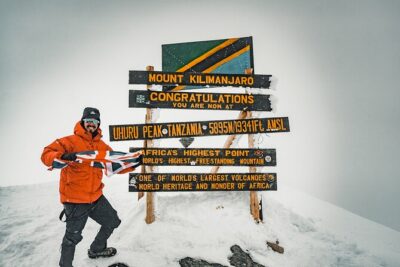
The Best of Machame Route in 6 Days: Your World’s Summit Guide
Read our review →Browse the lists this tour appears in