
Reviewed · MACHAME ROUTE CLIMBS
7-Day Guided Mount Kilimanjaro Climb by Machame Route
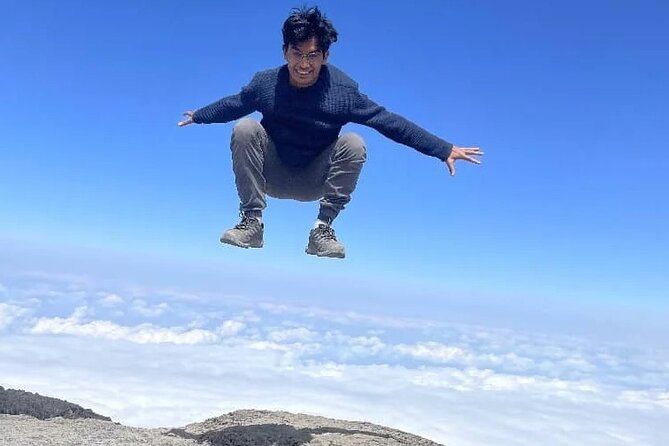
The mountain changes by the hour. This 7-day Machame Route climb takes you from Moshi through rainforest, moorland, high desert, glaciers, and the summit of Africa. I like the route’s changing scenery and its careful acclimatization schedule, especially the Lava Tower to Barranco descent. I also like that the price includes park, camping, rescue, meals, crew wages, airport transfers, and two hotel nights.
The main caution is simple: Machame is not a gentle walk. The trail has steep sections, long days, loose scree, and several ups and downs. You need moderate physical fitness, patience, and a willingness to sleep in tents at high altitude. The advertised maximum of 100 people is also worth clarifying before you book, since group size can affect the feel of the climb.
In This Review
- Key points at a glance
- Why the Machame Route earns its nickname
- What the $2,180 price really covers
- Day 1: Moshi to Machame Camp through rainforest
- Day 2: Heather and moorland on the way to Shira
- Day 3: Lava Tower, the Shark’s Tooth, and Barranco
- Day 4: The Barranco Wall and a useful short day
- Day 5: Karanga to Barafu and the South Circuit
- Day 6: Stella Point, Uhuru Peak, and the long descent
- Day 7: Mweka Gate and the return to Moshi
- Food, crew, and the human side of the climb
- Who should book this climb?
- Practical details before you commit
- FAQ
- How long is the Machame Route climb?
- What time does the experience start?
- Is airport pickup included?
- What meals are included?
- Are park and camping fees included?
- Is travel insurance included?
- How difficult is the Machame Route?
- When does the summit attempt begin?
- Can I cancel for a full refund?
- Should you book the 7-day Machame climb?
Key points at a glance
- Seven days gives you a better acclimatization rhythm: The climb includes a high point at Lava Tower before descending to Barranco, plus short days at Karanga and Barafu.
- The scenery changes dramatically: You walk from Kilimanjaro’s rainforest to heather, moorland, semi-desert, alpine desert, and the snowy summit zone.
- Summit night starts around midnight to 2 a.m.: You climb through scree toward Stella Point, then continue to Uhuru Peak before descending to Mweka.
- The $2,180 price covers many major costs: Park, camping, rescue, VAT, crew, food, airport transfers, and two nights of accommodation are included.
- The mountain crew is central to the experience: Guides, cooks, and porters are provided, with fair wages included in the package.
- Muddy lower trails require the right kit: Gaiters and trekking poles are useful on the first and final days, especially after rain.
Why the Machame Route earns its nickname
Machame is often called the whiskey route, a playful contrast with the easier-sounding Marangu route. The nickname hints at the route’s character: it is steeper, rougher, and more demanding, but it also offers more varied scenery and a stronger sense of adventure.
You begin on the southern side of Kilimanjaro, then curve east beneath the mountain’s southern ice fields before heading toward the summit. The trail crosses ridges and valleys rather than simply climbing in a straight line. That means more visual variety, but also more tiring ups and downs.
This is not a technical mountaineering trip. You do not need rock-climbing skills from the information provided. Still, the route can be exhausting, particularly for someone who has little hiking experience. The seven-day version is the sensible choice over the six-day minimum because it gives your body more time to adjust to altitude.
The most useful feature is the climb high, sleep lower pattern on Day 3. You reach Lava Tower at about 16,000 feet, then descend to Barranco Camp at roughly 13,000 feet. That day adds effort, but it helps prepare you for the summit push.
More Kilimanjaro climbs:
- Kilimanjaro climb by Lemosho Route (7-day)
★ 5.0 · 651 reviews - Kilimanjaro climb, Machame Route (7-day)
★ 5.0 · 262 reviews - Kilimanjaro Climbing Lemosho Route 8 Days.
★ 5.0 · 186 reviews
What the $2,180 price really covers
At $2,180 per person, this is not a budget day trip. Kilimanjaro requires park access, camping, food, crew, transport, and rescue arrangements, so the right question is what the price removes from your planning list.
This package includes:
- Professional guides, cooks, and porters
- Park fees, camping fees, and rescue fees
- VAT and other listed charges
- Airport pickup and drop-off
- Fair wages for the mountain crew
- Two nights of accommodation in Moshi or Arusha, before and after the climb
- Six breakfasts, six dinners, and seven lunches
That is a substantial package. Airport transfers and hotel nights are especially useful if you are arriving internationally and want the climb handled as one connected arrangement. The included rescue fee also matters on a high-altitude route, though you still need your own insurance because insurance is not included.
Tips for the driver, guide, and hotel staff are also excluded. International flights are excluded, and the wording about the cost of Tanzania is unclear, so ask the company to explain any government or local charges not already covered.
The experience is usually booked about 34 days ahead. I would not leave it until the last week, particularly if you need time to arrange insurance, flights, clothing, and altitude preparation.
Day 1: Moshi to Machame Camp through rainforest
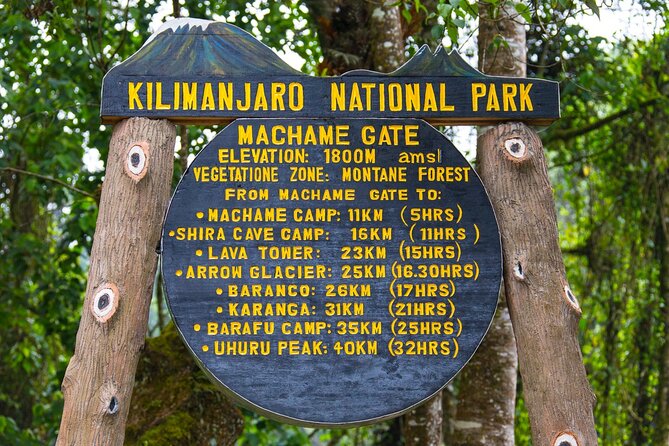
The drive from Moshi to the Mount Kilimanjaro National Park Gate takes about 50 minutes. The route passes through Machame village on the mountain’s lower slopes, then you begin walking through rainforest.
The first day covers about 11 kilometers and takes five to seven hours. You climb from approximately 5,400 feet to 9,400 feet, ending at Machame Camp. The forest is the main attraction here, but it also creates the first practical challenge: the lower trail can be muddy and slippery.
Pack your gaiters and trekking poles where you can reach them quickly. This is not the day to bury them at the bottom of your bag. Rain gear should also stay handy, since conditions in the forest can change quickly.
The climb is long enough to test your pace, but it is not the hardest day. Start slowly. You have a mountain ahead of you, not a race to camp.
Day 2: Heather and moorland on the way to Shira
After breakfast, the trail leaves the rainforest behind. You climb across a small valley and follow a steep, rocky ridge covered with heather before turning west toward a river gorge.
This is a shorter day by distance, about 5 kilometers, but it still takes four to six hours. The elevation rises from 9,400 feet to 12,500 feet. You sleep at the Shira campsite in moorland.
The short distance does not mean the day is effortless. At this altitude, every slope feels more serious. Your best tool is a steady pace and regular rest. The open setting also exposes you more to sun and wind than the forest did, so carry water and sun protection where you can use them.
Shira is an important transition point. You have left the thick lower forest and entered a more open, high-altitude zone. The mountain begins to feel less like an ordinary hike and more like a sustained climb.
More Machame Route climbs:
- Climbing Kilimanjaro – Machame Route
★ 5.0 · 170 reviews - Climbing Kilimanjaro through 7 days Machame Route
★ 5.0 · 151 reviews - 7 Days Kilimanjaro via Machame route affordable price
★ 5.0 · 110 reviews - #1. Best Kilimanjaro Day hike Tour-Machame Route-ISMANI
★ 4.2 · 47 reviews
Day 3: Lava Tower, the Shark’s Tooth, and Barranco
Day 3 is the route’s key acclimatization day. From the Shira Plateau, you head east along a ridge, pass the junction toward Kibo, and continue southeast toward Lava Tower, also called the Shark’s Tooth.
The planned elevation range is from 12,500 feet to 13,000 feet, but the trail reaches about 16,000 feet at the Arrow Glacier junction before dropping to Barranco Camp. You cover roughly 10 kilometers in six to eight hours through semi-desert.
This high climb followed by a lower night is exactly why the day matters. You work above your sleeping elevation, then give your body a chance to recover at Barranco. It is tiring, but skipping this kind of adjustment would make the summit effort less forgiving.
You may encounter cold conditions and snow during the higher section. The route is not described as technically difficult, but the altitude and loose ground can make it feel demanding. Keep your pace conservative and listen carefully to your guide.
Barranco is one of the more memorable camps because the day has taken you through several high-altitude forms in a single stretch. It is also the point where the climb begins to feel serious for nearly everyone.
Day 4: The Barranco Wall and a useful short day
After breakfast, you leave Barranco and climb the steep ridge beside the Barranco Wall. The route continues to Karanga Valley Camp, only about 3 miles away.
The day takes four to five hours and rises slightly from 13,000 to 13,100 feet. The habitat is alpine desert. On paper, the small elevation gain may look insignificant, but that misses the point. This is a shorter day designed to help with acclimatization before the bigger push to Barafu.
The Barranco Wall is a steep section, so you should expect a slower, more deliberate pace. The provided details do not describe it as a technical climbing section, but it is still a place where good footwear, balance, and patience matter.
I like the rhythm here. After the long Day 3, you get a shorter stage rather than another huge effort. That makes the seven-day plan more appealing than the six-day minimum for anyone who wants a little more breathing room.
Day 5: Karanga to Barafu and the South Circuit

From Karanga, you reach the junction connecting with the Mweka Trail, then continue upward to Barafu Hut. The distance is about 2.5 miles, with four to five hours of hiking.
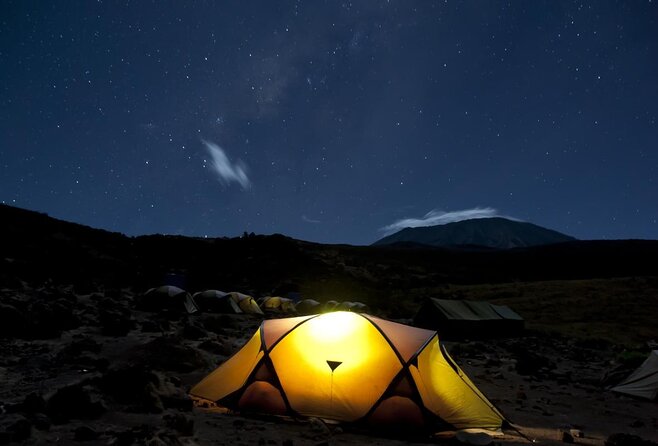
You climb from around 13,000 feet to 15,300 feet through alpine desert. Barafu is your staging point for summit night, so the day is not just about reaching camp. You need to eat, drink, rest, and organize your clothing and equipment before the midnight-to-2 a.m. start.
At Barafu, you have completed the South Circuit, which provides views of the summit from several angles. The two major peaks, Mawenzi and Kibo, are visible from this position. The setting gives you a clear sense of the mountain’s scale, but it also reminds you that the hardest section is still ahead.
Do not expect a full night of sleep. The early start makes this a strange day, with dinner and rest coming before most people would normally go to bed. Keep your summit clothing ready and avoid unnecessary packing once you reach camp.
Day 6: Stella Point, Uhuru Peak, and the long descent
Summit day begins very early, usually between midnight and 2 a.m. You head northwest between the Rebmann and Ratzel glaciers, climbing through heavy scree toward Stella Point on the crater rim.
The ascent is slow and demanding. At Stella Point, you get a short rest and, weather permitting, a sunrise over the mountain. The final hour to the summit may be snowy. The cold, darkness, altitude, and loose scree combine to make this the most difficult part of the climb.
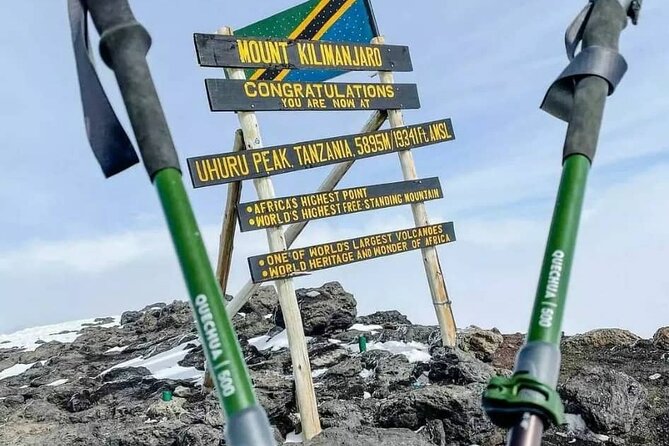
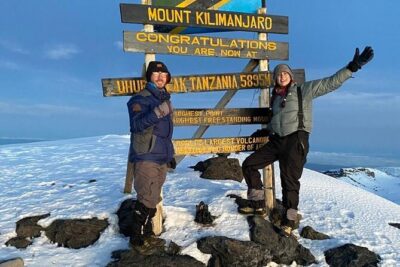
From Stella Point, you continue to Uhuru Peak, the highest point on Mount Kilimanjaro and the highest point in Africa. Faster hikers may reach the summit in time for sunrise, but the schedule allows for sunrise near Stella Point as well. Reaching the top is the goal, yet the descent requires just as much care.
After the summit, you descend toward Mweka Hut. This is a very long day, and the details provided do not give a complete hiking time or distance for the entire stage. Plan mentally for a full day on your feet, with the summit effort followed by a substantial descent.
This is where your guide and support crew matter most. The company provides guides, cooks, and porters, and the supplied praise repeatedly highlights the care of the Kisaza team. Names specifically associated with positive feedback include Stephen, Michael, Francis, Louis, David, Ezekiel, and Lusekelo. The comments emphasize prompt communication, airport transfers, organization, and supportive mountain service.
Day 7: Mweka Gate and the return to Moshi
After breakfast, you continue down to Mweka Park Gate. The descent takes about three to four hours and covers roughly 6 miles, dropping from about 10,000 feet to 5,400 feet through rainforest.
The lower trail can be wet and muddy. Gaiters and trekking poles are useful again, while shorts and a T-shirt may be comfortable at lower elevations. Keep rain gear and warmer clothing nearby because the weather can still shift.
At the gate, you receive your summit certificates. You then walk about another hour to Mweka village, where a vehicle takes you back to your hotel in Moshi.
The return transfer is a welcome finish. After seven days of changing camps and altitude, having transport arranged from the village saves you from solving one more practical problem while tired.
Food, crew, and the human side of the climb
Six breakfasts, six dinners, and seven lunches are included. Cooks are part of the mountain team, so you do not need to organize every meal yourself while climbing. The provided information does not give menus or special-diet details, so ask in advance if you have food restrictions.
Porters and guides also shape the climb. Fair wages are included, which is an important point when comparing operators. You should still confirm the company’s tipping guidance before departure, since tips are not included.
The strongest praise for Kisaza focuses on service before and after the hike as well as on the trail. Communication through WhatsApp, proactive answers, airport pickup, and the hotel arrangements were all highlighted in the feedback provided. One group of 11 described the overall service as friendly and helpful, while other accounts praised the team for handling Kilimanjaro alongside Mount Meru and safari arrangements.
The overall score is listed as 5 from nine reviews. That is encouraging, though still a small sample. I would treat it as a positive signal rather than a guarantee that every group will have the same experience.
Who should book this climb?
This route suits you if you have some hiking or trekking experience and want a more adventurous route than Marangu. It also suits you if varied scenery matters as much as reaching the summit.
You should be comfortable with:
- Five to eight hours of hiking on several days
- Steep ridges and loose scree
- Sleeping at high altitude
- A midnight-to-2 a.m. summit start
- Muddy trails in the rainforest
- A long summit day followed by a major descent
First-time climbers can take this route, but the description itself warns that it may feel tiring. The seven-day version gives you a better chance to manage the altitude than a compressed six-day schedule, but it does not turn the climb into an easy walk.
The advertised maximum is 100 people. That is a large possible group, even if actual departures may be smaller. Ask how many people are expected on your date, who your lead guide will be, and how the crew is organized.
Practical details before you commit
Pickup is offered, with the meeting point listed as Kilimanjaro International Airport and a 9 a.m. start time. The activity ends back at the meeting point, although the day-by-day plan also describes transport to a hotel in Moshi after Mweka village. Confirm the exact arrival and departure arrangements before booking.
You receive confirmation at booking. The activity is near public transportation, but most people using this package will likely value the included airport and hotel transfers more than local transit.
Free cancellation is available if you cancel at least 24 hours before the local start time. Cancellations or changes made inside that window are not accepted for a refund. Insurance remains your responsibility.
FAQ
How long is the Machame Route climb?
The climb lasts approximately seven days, including the return to Mweka Gate and transfer back toward Moshi.
What time does the experience start?
The listed start time is 9:00 a.m., with the meeting point at Kilimanjaro International Airport.
Is airport pickup included?
Yes. Airport pickup and drop-off are included, and the package also includes two nights of accommodation in Moshi or Arusha before and after the climb.
What meals are included?
The package includes seven lunches, six breakfasts, and six dinners.
Are park and camping fees included?
Yes. Park fees, camping fees, rescue fees, VAT, and listed charges are included.
Is travel insurance included?
No. Insurance fees are excluded, so you need to arrange your own coverage.
How difficult is the Machame Route?
The route is not technically difficult, but it is steeper and more exhausting than the Marangu route. It includes long walks, rocky ridges, loose scree, and high-altitude sections.
When does the summit attempt begin?
The summit climb begins very early, between midnight and 2 a.m.
Can I cancel for a full refund?
Yes, if you cancel at least 24 hours before the experience start time. Cancellations or changes made less than 24 hours before the start are not accepted for a refund.
Should you book the 7-day Machame climb?
I would choose this trip if you want Kilimanjaro’s changing scenery, prefer a more adventurous route, and value having transport, hotels, meals, permits, and a mountain crew arranged together. The $2,180 price is easier to justify because it includes many of the expensive essentials, including rescue fees and fair crew wages.
I would hesitate if you have little hiking experience, dislike camping, or want a relaxed sightseeing trip. Ask about the expected group size, tipping, insurance requirements, food needs, and any unclear Tanzania charges before paying.
For a fit, prepared hiker, the seven-day schedule offers a strong balance of scenery and acclimatization. Machame will still test you, but the route’s careful high-and-low rhythm gives you a fair shot at Uhuru Peak without rushing the mountain.
Just added in Moshi
- Zanzibar: Stone Town tour and Nakupenda beach with Lunch★ 5.0 · 1 review
- day trip lake manyara★ 5.0 · 2 reviews
- Mt Kilimanjaro 6 days Marangu route hike★ 5.0 · 3 reviews
- machame route★ 5.0 · 16 reviews
- Private Cycle to Kilimanjaro Bike Park Safari★ 5.0 · 6 reviews
- West Kilimanjaro cycling Adventures★ 4.5 · 8 reviews
- Wildlife Extravaganza: Manyara, Tarangire & Ngorongoro in 3 Days★ 5.0 · 3 reviews
- 3 Days Private E-Bike Tour in West Kilimanjaro★ 5.0 · 3 reviews
Machame Route Climbs, compared.



Climbing Kilimanjaro through 7 days Machame Route
Read our review →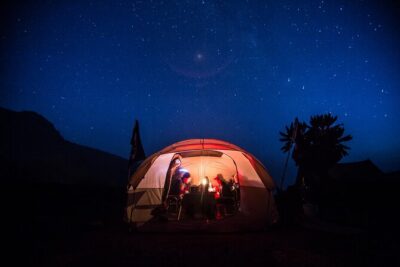
7-Day Machame Kilimanjaro Summit Tour from Arusha
Read our review →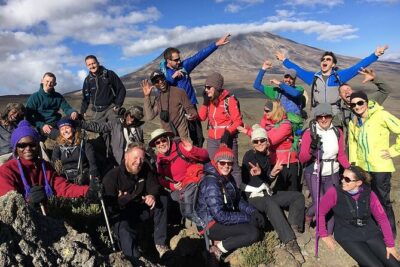
7 Days Kilimanjaro via Machame route affordable price
Read our review →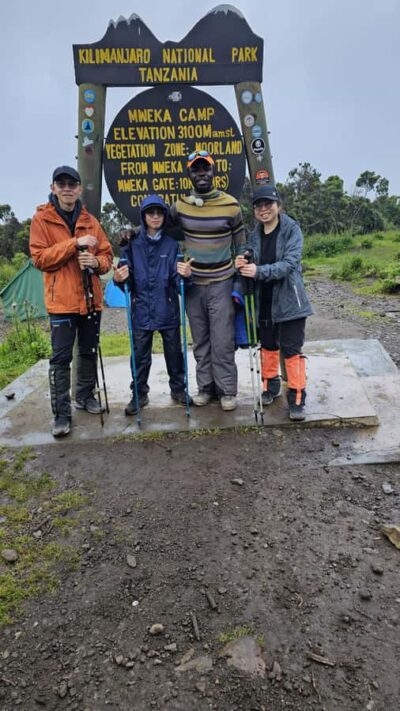
#1. Best Kilimanjaro Day hike Tour-Machame Route-ISMANI
Read our review →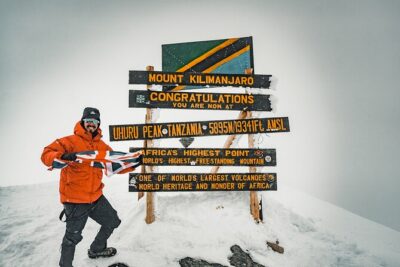
The Best of Machame Route in 6 Days: Your World’s Summit Guide
Read our review →Browse the lists this tour appears in