
Reviewed · LEMOSHO ROUTE CLIMBS
Kilimanjaro Climbing Lemosho Route 8 Days.
The mountain changes every day. This private Kilimanjaro climb follows the Lemosho Route from rainforest to Uhuru Peak, with a guide, porters, camp meals, hotel nights, and safety equipment included. I like the slower eight-day schedule, which gives you more time to adjust to altitude, and I like that your own group sets the pace rather than joining a large mixed party.
I also appreciate the pre-climb gear check in Moshi and the practical safety kit, including pulse oximeters, first-aid supplies, and emergency oxygen. The main consideration is the summit push: Day 8 can last about 12 to 14 hours, with a midnight start, steep scree, cold conditions, and a long descent afterward. This is a serious high-altitude trek, not a casual hike.
In This Review
- Key details before you book
- What you are really buying for $2,300
- Day 1: A useful Moshi arrival and gear check
- Day 2: Rainforest from Londorossi Gate to Mti Mkubwa
- Day 3: Moorland and the open Shira plateau
- Day 4: Shorter walking and an acclimatization outing
- Day 5: Lava Tower, 4,600 meters, then Barranco
- Day 6: The Barranco Wall and Karanga Camp
- Day 7: Barafu Camp and a long wait for midnight
- Day 8: Stella Point, Uhuru Peak, and the long descent
- Day 9: Forest, certificates, and a hot shower in Moshi
- Guides, porters, and the feel of a private climb
- Who should choose this Lemosho trek?
- Booking, weather, and cancellation details
- Should you book it?
- FAQ
- How long does the full Kilimanjaro experience last?
- What is included in the $2,300 price?
- What is not included?
- How difficult is the trek?
- What altitude does the route reach?
- Can I cancel for a full refund?
Key details before you book
- A private eight-day route with nine scheduled days: The climb itself takes eight mountain days, but the full plan includes airport pickup, a Moshi hotel arrival day, and a hotel night after the descent.
- Lemosho gives you a gradual start: You move from rainforest to moorland, alpine desert, and finally the summit zone, with several days for altitude adjustment.
- The summit day is the real test: You climb from Barafu Camp around midnight, reach Stella Point at 5,756 meters, continue to Uhuru Peak at 5,895 meters, then descend to Mweka Camp.
- Safety support is built into the price: Pulse oximeters, first-aid equipment, and emergency oxygen are provided, along with professional mountain guides and porters.
- Meals and hotel nights are covered: Breakfast, lunch, and dinner are included during the trip, plus two hotel nights in Moshi.
- The private format adds flexibility: Your guide can adjust the walking pace for your group, a point praised repeatedly in accounts of this operator’s climbs.
What you are really buying for $2,300
The price is $2,300 per person. That is not just a fee for a guide walking beside you. It covers park-related costs, private transport, two hotel nights, all mountain meals, camping support, porters, and the equipment used to monitor and respond to altitude problems.
For a Kilimanjaro trip, that makes the price look reasonable, especially if you value having the practical work handled for you. You are not arranging meals at camp, carrying the full load of supplies, or sorting out every transfer on your own.
Still, $2,300 is not the final cost. You need to budget separately for flights, a Tanzanian entry visa, laundry, and tips for the mountain crew. Tipping matters here because the guides, cooks, and porters carry out much of the work that makes the climb possible. Ask the operator before departure for current tipping guidance and the expected crew structure.
The booking pattern also matters. This experience is commonly reserved about 147 days ahead, so you should not treat it as a last-minute Moshi activity. Dates around popular climbing seasons may fill well in advance.
More Kilimanjaro climbs:
- Kilimanjaro climb by Lemosho Route (7-day)
★ 5.0 · 651 reviews - Kilimanjaro climb, Machame Route (7-day)
★ 5.0 · 262 reviews - Kilimanjaro climb, Lemosho Route (8-day)
★ 5.0 · 148 reviews
Day 1: A useful Moshi arrival and gear check
Your trip begins with pickup at Kilimanjaro International Airport and a transfer to a hotel in Moshi. The drive and initial arrival process take about an hour, followed by dinner and an overnight stay.
The useful part of this day is the briefing and equipment check. Your guide goes through the gear needed for the climb and helps identify anything missing before you enter the park. That can save you from discovering at altitude that your clothing, footwear, or other basic equipment is not suitable.
I would arrive in Tanzania with enough time to rest. The schedule starts early the next morning, and the climb begins with a long transfer followed by several hours on foot. A calm first day is far more useful than trying to squeeze in extra sightseeing.
Day 2: Rainforest from Londorossi Gate to Mti Mkubwa
After breakfast, you drive for about two hours from Moshi, at roughly 910 meters, to Londorossi Park Gate at 2,100 meters. The guide and porters register at the gate, organize the supplies, and prepare the equipment before you start walking.
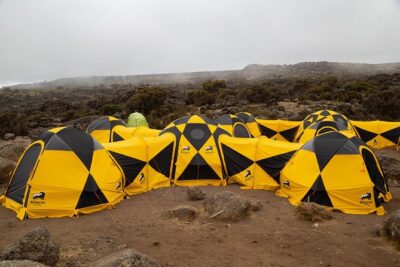
The first trail section passes through rainforest. You hike for about seven hours and finish at Mti Mkubwa Camp, at 2,980 meters, where your tent is already prepared and your personal belongings are placed inside.
This is a satisfying introduction to the route because the vegetation changes quickly and the forest gives you a clear sense that you have left ordinary roads behind. The drawback is the combination of a long drive, registration, gear preparation, and a full walking day. You may feel that the first day starts slowly, then becomes quite demanding.
Your support crew makes a big difference here. You carry only what you need for the day, while porters handle the larger camping load. Even so, you should not rush. The guiding approach is designed around steady movement and responsible altitude gain.
Day 3: Moorland and the open Shira plateau
The trail leaves the forest behind and reaches grassy moorland scattered with heather and volcanic rock. This day covers about 7 kilometers and takes roughly four hours, ending at Shira I Camp at 3,500 meters.
Some sections are fairly steep, but the reward is a wider view toward Kibo and the Shira plateau. The change from enclosed forest to open high country is one of the route’s strongest features. You can see more of the mountain and begin to understand its broad scale.
The short hiking time may sound easy, but altitude can make a four-hour walk feel longer than expected. Drink regularly, walk slowly, and tell your guide if you develop a headache, nausea, unusual fatigue, or trouble breathing. The point of this day is not speed. It is to reach camp in good shape for the days ahead.
More Lemosho Route climbs:
- Kilimanjaro climb, Lemosho Route (6-day)
★ 5.0 · 129 reviews - Kilimanjaro Lemosho Route
★ 5.0 · 71 reviews - Private Kilimanjaro Hike 7 Day Lemosho Route
★ 5.0 · 60 reviews - Climbing Kilimanjaro through 8 days Lemosho Route
★ 5.0 · 52 reviews
Day 4: Shorter walking and an acclimatization outing
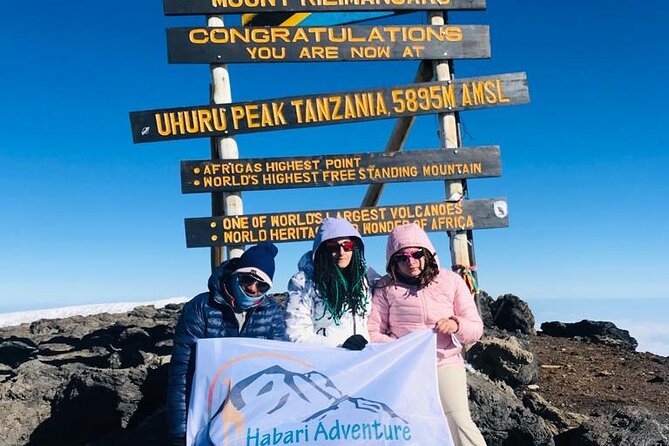
Day 4 stays in moorland and covers about 8 kilometers in five hours. The route is described as one of the shorter and less steep days, with views of Kibo and the northern ice fields from the western side of the mountain.
After lunch at camp, you have tea around 4:00 p.m., then take an acclimatization walk before returning for dinner and the night. That extra walk is valuable because it gives your body more time at altitude without forcing you to climb a major distance.
I like this pause in the schedule. It gives you time to look around, sort your gear, and recover before the tougher section. The camp routine can feel repetitive, though. You will walk, eat, rest, and sleep, with little privacy beyond your tent and no luxury facilities on the mountain.
Day 5: Lava Tower, 4,600 meters, then Barranco
This is a key altitude day. You climb through alpine desert toward Lava Tower at 4,600 meters, then descend to Barranco Camp at 3,900 meters. The distance is about 10 kilometers, and walking time is around six hours.
The ascent to Lava Tower lets you spend time at a higher elevation before sleeping lower at Barranco. That climb-high, sleep-lower pattern is useful for acclimatization, even though it can leave you feeling tired. You may find the air thinner and the pace noticeably slower.
The descent toward Barranco takes about three hours and gives you views of the Western Breach and Barranco Wall. The camp sits in a valley below the wall, with a memorable sunset setting if the weather cooperates.
This day is a good example of why the eight-day plan has value. The route does not simply race upward. It gives you a controlled exposure to a higher altitude, then brings you down for the night. The downside is that some people find the repeated climbing and descending frustrating when they are already tired.
Day 6: The Barranco Wall and Karanga Camp
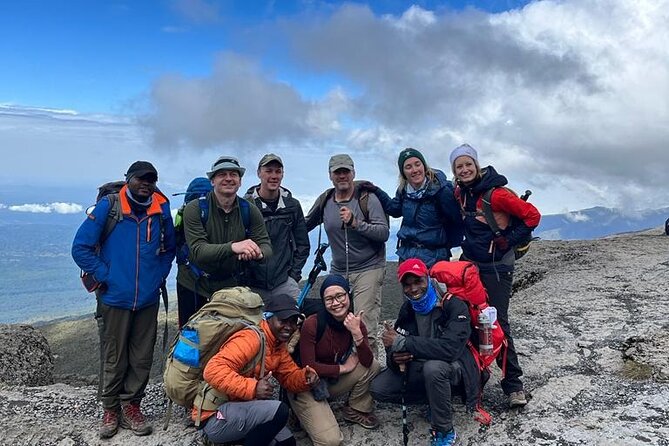
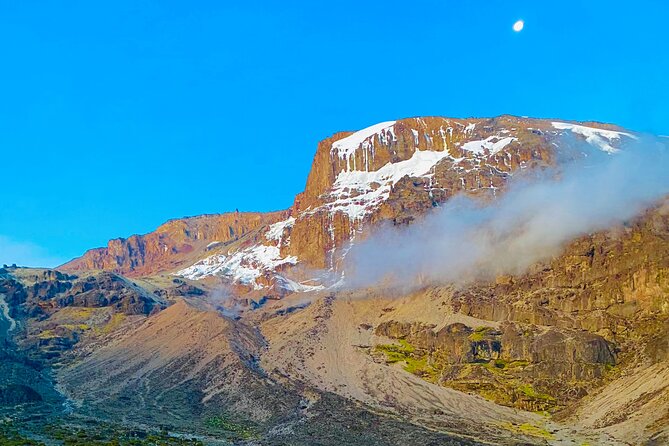
After breakfast, you climb Barranco Wall, reaching about 4,200 meters, then continue toward Karanga Camp at 4,000 meters. The walk covers around 6 kilometers and takes approximately four hours, though the daily schedule also allows time for the full camp routine.
Barranco Wall is one of the most memorable sections of the route. It is not a technical rock climb based on the information provided, but you should expect a steeper, more hands-on trail than the earlier moorland paths. Your guide controls the pace and helps the group move carefully through the more demanding section.
The scenery becomes increasingly stark, with alpine desert replacing the softer vegetation below. Karanga is important because it breaks the climb toward Barafu into manageable stages. You are still working hard, but you avoid making the approach to the summit one huge uphill day.
Day 7: Barafu Camp and a long wait for midnight
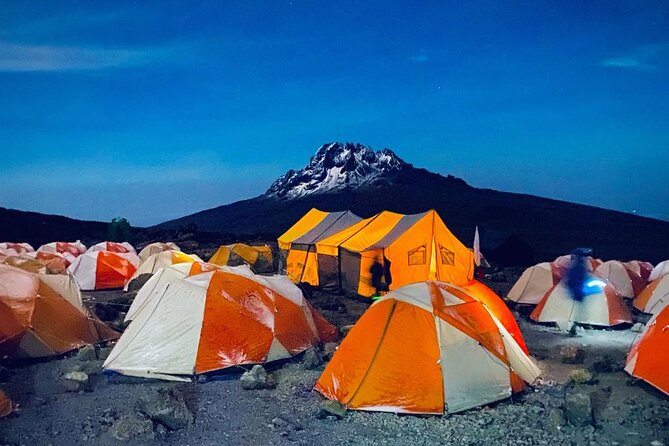
The walk to Barafu Camp is relatively short, about 4 kilometers and three hours. You climb to 4,640 meters, with views toward Kibo and Mawenzi peaks.
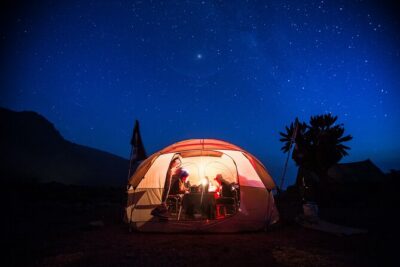
After reaching camp, you eat lunch and rest for much of the afternoon. Dinner comes early, and you try to sleep before getting up around midnight for the summit attempt.
This day can be harder mentally than physically. You may arrive at camp early, but the summit is still ahead and sleep can be difficult at 4,640 meters. Keep your summit clothing, water, snacks, and headlamp ready before lying down. The fewer decisions you need to make at midnight, the better.
The private arrangement helps here. Your guide can pay attention to your group’s condition and adjust the approach if someone is struggling. Accounts of this operator frequently praise guides such as Yusuph, Abdi, Michael, Ema, and others for their encouragement, careful pacing, and personal attention. Names and crew assignments can vary, so confirm your guide before departure.
Day 8: Stella Point, Uhuru Peak, and the long descent
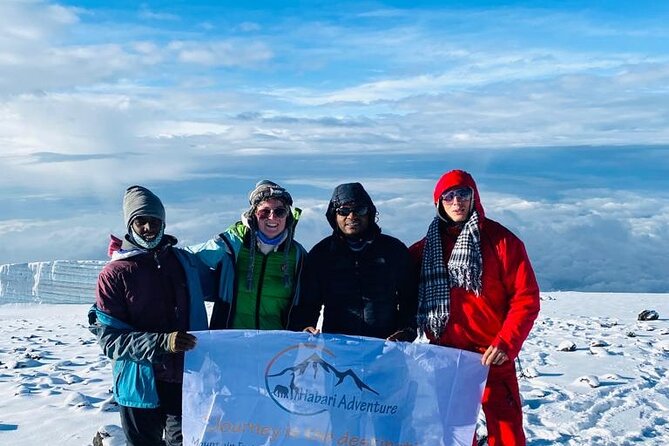
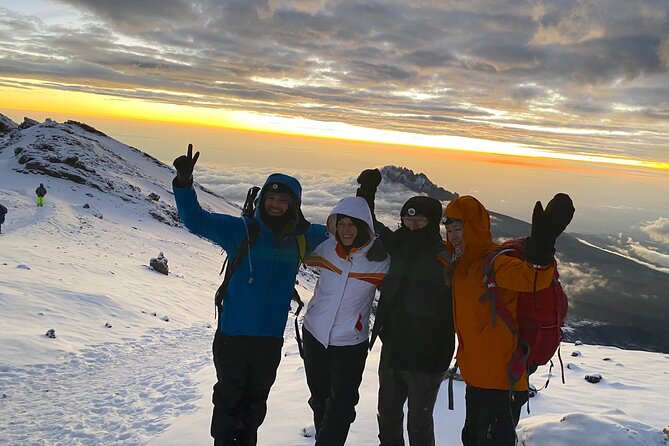
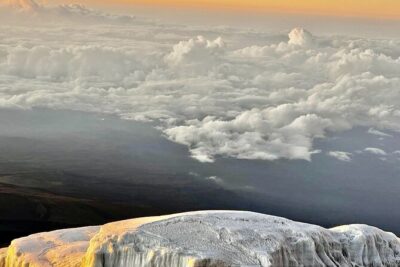
Summit day begins around midnight with light tea and cookies. You climb scree for four to five hours toward Stella Point on the crater rim at 5,756 meters, aiming to arrive around sunrise.
From Stella Point, it takes about another hour to reach Uhuru Peak at 5,895 meters. You have a few minutes for photographs, then begin the descent to Barafu Camp for lunch and a rest. The day continues down to Mweka Camp at 3,100 meters, with a total distance of about 21 kilometers.
This is the emotional high point of the trip, but it is also where you need the most honesty about your fitness and altitude response. The summit path is dark at first, cold, steep, and slow. Reaching the crater rim is a major achievement, and Uhuru Peak is still another hour away.
The descent is not an easy finish. Your legs have already worked for many hours, and loose scree can be tiring on the way down. The break at Barafu gives you some recovery, but you still have a substantial walk to Mweka. Listen closely to your guide and do not treat the summit photograph as the end of the day.
The safety equipment is reassuring, but it does not remove the risks of high altitude. A pulse oximeter and emergency oxygen are useful tools for the crew, not a substitute for careful pacing, honest communication, or a guide’s judgment.
Day 9: Forest, certificates, and a hot shower in Moshi
The final walk takes about three hours and covers 10 kilometers through Mweka’s montane forest. You finish at Mweka Gate, complete park formalities, and receive a summit certificate before the vehicle takes you back to your Moshi hotel.
This ending is simple and welcome. After the exposed alpine zones, the forest feels warmer and softer, and the hotel shower gives you a small luxury that you will appreciate more than usual.
The schedule lists nine dinners and eight breakfasts and lunches, along with two hotel nights. The exact meal arrangements should be confirmed before departure, but the plan is designed so you do not need to shop for food during the climb.
Guides, porters, and the feel of a private climb
The strongest praise for this operator centers on the mountain crew. Guides are repeatedly described as supportive and attentive, while porters and cooks receive special credit for keeping the climb running. Names connected with particularly positive accounts include Yusuph, Abdi, Michael, Ema, George, MK, Johnson, Awali, Humphrey, and others.
One practical benefit is pace control. A private group can stop when needed, move slowly on steep ground, and avoid being forced to match an unsuitable pace. That is especially useful if people in your party have different hiking speeds.
The private format does not mean the climb is easy or isolated. Your group still depends on a larger support team, and the crew’s work is central to your comfort and safety. Be prepared to show respect, follow park rules, and budget properly for tips.
Who should choose this Lemosho trek?
I would recommend this trip to you if you want a structured Kilimanjaro climb with private support and a gradual route. It suits people who prefer having transport, meals, camping, hotel accommodation, and gear checks organized in advance.
You need a moderate level of physical fitness. The route includes several four-to-seven-hour walking days, a high-altitude climb to Lava Tower, the Barranco Wall, and a summit day lasting up to 14 hours. You should be comfortable with long days on uneven ground and with basic camping conditions.
I would think twice if you want a short, comfortable holiday with a little mountain walking. The itinerary is demanding, and the summit day leaves little room for tired legs or poor preparation.
The tour allows service animals and is near public transportation, but this is still a remote mountain activity. Those details should not be confused with easy access on the trail.
Booking, weather, and cancellation details
Pickup is offered from Kilimanjaro International Airport, with an advertised start time of 8:00 a.m. Confirmation is provided when you book. The experience requires suitable weather and a minimum number of participants, although it is sold as a private activity for your own group.
You can cancel up to 24 hours before the local start time for a full refund. A cancellation made within 24 hours is not refundable, and late changes are not accepted. If poor weather or an insufficient number of participants causes the operator to cancel, you are offered another date or experience, or a full refund.
Should you book it?
I would book this Lemosho climb if you value a private pace, a longer acclimatization schedule, and strong crew support. The route gives you excellent variety, from rainforest and moorland to alpine desert, and the included meals, hotel nights, transport, safety supplies, and camping support provide solid value at $2,300.
I would not book it without checking the current gear list, tipping expectations, crew details, and the exact hotel arrangements. Go in knowing that the title says eight days, while the full schedule takes nine days, and that summit day is a demanding overnight effort.
For a prepared hiker who wants a well-supported route to Uhuru Peak, this is a sensible and appealing choice. The mountain still makes the final decision, but good pacing and a capable local team give you the best possible chance of reaching the top.
FAQ
How long does the full Kilimanjaro experience last?
The schedule covers nine days in total. The mountain climb is described as an eight-day Lemosho trek, with an arrival and hotel day before the mountain portion and a return to Moshi on the final day.
What is included in the $2,300 price?
The price includes fees and taxes, private transportation, two hotel nights, mountain meals, and safety equipment including a pulse oximeter, first-aid kit, and emergency oxygen. Eight breakfasts, eight lunches, and nine dinners are included.
What is not included?
Flights, a Tanzanian entry visa, laundry services, and tips for the mountain crew are not included.
How difficult is the trek?
A moderate level of physical fitness is required. The trek includes walking days of up to seven hours, high-altitude sections, the Barranco Wall, and a summit day of about 12 to 14 hours.
What altitude does the route reach?
Uhuru Peak is at 5,895 meters. The route also reaches Lava Tower at 4,600 meters, Barafu Camp at 4,640 meters, and Stella Point at 5,756 meters.
Can I cancel for a full refund?
Yes. You can cancel at least 24 hours before the experience’s local start time for a full refund. Cancellations or changes made less than 24 hours before the start are not accepted for a refund.
Just added in Moshi
- THE BEST 2 DAYS ON TREK – MARANGU ROUTE TOUR ADVENTURES★ 5.0 · 1 review
- Mount Kilimanjaro National Park Day Trip★ 5.0 · 7 reviews
- Mount Kilimanjaro Climbing in Tanzania Full-Day Trip★ 5.0 · 1 review
- Mount Kilimanjaro Day Hike – All-Inclusive, No Hidden Fees★ 4.0 · 7 reviews
- Mount Kilimanjaro Trekking Tour – Climb with Local Guides★ 5.0 · 1 review
- Mount Kilimanjaro: 7 Days Hike Lemosho Route★ 5.0 · 1 review
- Moshi:Chemka Hot Springs, Materuni Waterfalls & Coffee Tour★ 5.0 · 1 review
- Moshi/Arusha kikuletwa Hot Springs Tour★ 5.0 · 1 review
Lemosho Route Climbs, compared.
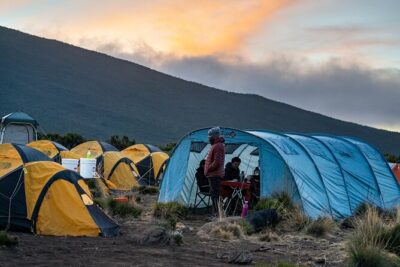
8-Day Small-group Lemosho Kilimanjaro Summit Trekking
Read our review →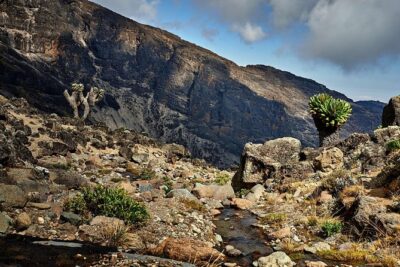
Climbing Kilimanjaro through 8 days Lemosho Route
Read our review →
Browse the lists this tour appears in