
Reviewed · LEMOSHO ROUTE CLIMBS
Mount Kilimanjaro Trek 7-Days: Lemosho Route
The mountain reveals itself slowly. This seven-day climb begins in Kilimanjaro’s quieter western forests, crosses the Shira Plateau, and reaches Uhuru Peak by way of the Barranco Wall and Barafu Camp. I like the wild Lemosho start, where you might spot antelope, buffalo, or even elephant, and I like the route’s gradual early altitude gain. The main concern is the summit day: 13 to 15 hours on foot makes this a serious physical test, not a casual holiday walk.
The $2,465.76 price is substantial, but it covers much more than guiding. Airport transfers, two hotel nights, park fees, meals, a cook, porters, emergency oxygen, and a full mountain crew are included. I also value the private format, since your group climbs together rather than joining a large public departure. Still, you must budget separately for flights, visas, insurance, personal gear, snacks, medicine, and tips.
In This Review
- Key points before you book
- Why the Lemosho Route is worth considering
- Day 1: From Moshi to Big Tree Camp
- Day 2: Moorland and Shira Camp 1
- Day 3: Shira Plateau and Northern Ice Field views
- Day 4: Lava Tower at 4,640 meters, then Barranco
- Day 5: Barranco Wall to Barafu Camp
- Day 6: Stella Point, Uhuru Peak, and the long descent
- Day 7: Mweka descent and return to Moshi
- What the $2,465.76 price really covers
- Service, organization, and the human side
- Who should choose this Kilimanjaro climb?
- Should you book it?
- FAQ
- Where does the Lemosho Route trek begin?
- How long does the Kilimanjaro trek last?
- Is pickup included?
- What is the highest point reached?
- Is the Barranco Wall a technical climb?
- Are meals included?
- What equipment and medical supplies are not included?
Key points before you book
- A quieter western approach: The route starts at Londorossi Gate, far from Moshi and even farther from Arusha, then enters one of Kilimanjaro’s less developed sides.
- A useful acclimatization pattern: You climb to Lava Tower at 4,640 meters on Day 4, then sleep lower at Barranco Camp, following the valuable climb-high, sleep-lower rhythm.
- Barranco Wall is demanding but nontechnical: You will use your hands at times and climb over rock, but no technical climbing skills are described as necessary.
- Summit night is the real test: The midnight start, scree, cold, altitude, and long descent make Day 6 far harder than the route distances alone suggest.
- A full support team is included: A qualified guide, assistant guides, porters, and cook handle the mountain operation, with meals and hot washing water provided.
- Strong service signals: One customer, Tony, specifically praised Wence and the company’s flexibility after a postponed trip. Another described the organization and crew as competent, cheerful, and committed.
Why the Lemosho Route is worth considering
Lemosho is a good choice if you want more than a direct push toward the summit. The route begins on Kilimanjaro’s western side, where the forest and high country feel less exposed to traffic and development than the busier approach routes.
You first reach Londorossi Gate by vehicle from Moshi. After registration, the drive continues for another 12 kilometers to the trailhead. That extra transfer makes the first morning longer, but it also places you deeper into the mountain before you start walking.
The route eventually joins the Machame route at Lava Tower. From there, it follows the southern circuit to Barranco, Karanga, and Barafu, then descends by Mweka. In practical terms, you get a broad crossing of the mountain rather than walking up and down the same path.
I especially like the way the first three days build altitude at a measured pace. You do not rush straight toward the summit. That matters on Kilimanjaro, where the ability to adjust to thinner air often matters as much as leg strength.
The route is private, so only your group participates. That gives you more control over walking speed, rest stops, and the general mood of the climb. It does not remove the physical demands, but it can make a difficult week feel more manageable.
More Kilimanjaro climbs:
- Kilimanjaro climb by Lemosho Route (7-day)
★ 5.0 · 651 reviews - Kilimanjaro climb, Machame Route (7-day)
★ 5.0 · 262 reviews - Kilimanjaro Climbing Lemosho Route 8 Days.
★ 5.0 · 186 reviews
Day 1: From Moshi to Big Tree Camp
Pickup is scheduled for about 8:00 in the morning from your hotel. You then drive toward Londorossi Gate, register with park authorities, and continue to the Lemosho trailhead.
The first walk covers about 7 kilometers and takes roughly four hours. Your destination is Big Tree Camp, reached through forest on the Lemosho glades.
This is a gentle introduction compared with what comes later. The forest provides shade and a softer setting for the first day, while the gradual pace gives you time to settle into the walking routine. I would use this day to test your boots, organize your daypack, and pay attention to how your body responds to the altitude.
The western side remains relatively wild. Large antelope, buffalo, and possibly elephant may be seen, although wildlife sightings are never guaranteed. Keep that possibility in mind, but do not treat the first day as a safari.
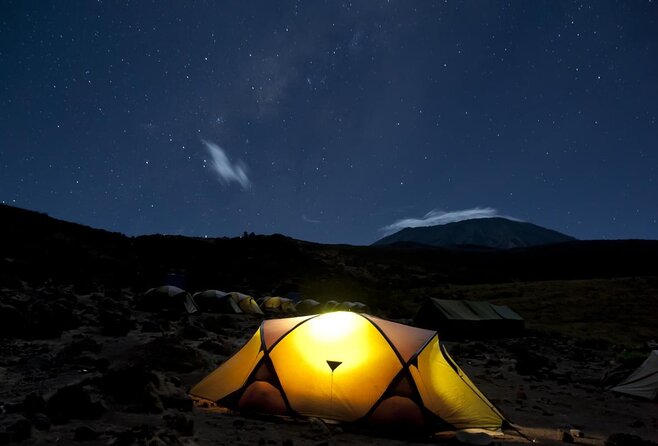
The overnight camp is basic mountain accommodation, and the supplied cook prepares dinner. Fresh drinking water and hot water for washing are included each day, a small comfort that becomes much more valuable after several hours on the trail.
Day 2: Moorland and Shira Camp 1
Day 2 covers 8.5 kilometers in about seven hours. The route leaves much of the forest behind and crosses grassy moorland and heather, with volcanic rocks scattered across the plateau.
This is where Kilimanjaro begins to feel large and exposed. The walking is not simply flat, and some sections are fairly steep. You gain a meaningful amount of altitude, so a slow pace is important.
Shira Camp 1 may offer views of Kibo Peak floating above the clouds. That image gives you a first clear sense of the summit’s scale, but the weather can change quickly, so do not count on a perfect view.
The seven-hour estimate is useful for planning, but it is not a promise. Your pace, rest periods, weather, and altitude response will affect the day. I would treat the schedule as a framework rather than a race to camp.
Day 3: Shira Plateau and Northern Ice Field views
The third day is shorter, at about 8 kilometers and five hours. You continue across the Shira Plateau toward Shira Camp 2, with broad views across the moorland.
The special feature here is the view toward Kilimanjaro’s Northern Ice Fields from the western side. The angle gives you a less familiar look at Kibo than the standard southern approach, and the volcanic forms make this one of the most visually interesting sections of the trek.
This day also helps with acclimatization. You keep walking at altitude without making an extreme gain in a single push. In the afternoon, you take an acclimatization walk, then return to camp for dinner and sleep.
That extra walk is easy to underestimate. It adds time when you may already feel tired, but it supports the gradual adjustment that the route is designed to provide. Drink steadily, eat even if your appetite fades, and tell your guide promptly if you feel unwell.
More Lemosho Route climbs:
- Kilimanjaro climb, Lemosho Route (8-day)
★ 5.0 · 148 reviews - Kilimanjaro climb, Lemosho Route (6-day)
★ 5.0 · 129 reviews - Kilimanjaro Lemosho Route
★ 5.0 · 71 reviews - Private Kilimanjaro Hike 7 Day Lemosho Route
★ 5.0 · 60 reviews
Day 4: Lava Tower at 4,640 meters, then Barranco
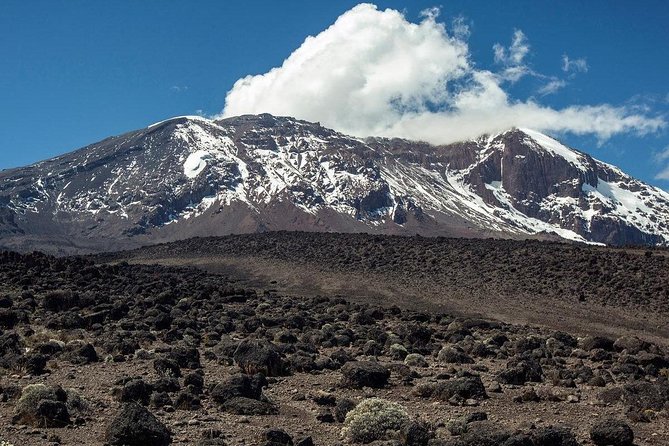
Day 4 is one of the most useful and memorable days of the route. You walk about 10 kilometers in roughly seven hours, climbing from the Shira area into the upland desert zone.
The route passes along lava ridges beneath the glaciers of the Western Breach. The high point is Lava Tower at 4,640 meters, where you stop for lunch.
Reaching this height during the day gives your body an important altitude exposure. The clever part is what follows: you descend to Barranco Camp at about 3,960 meters for the night. This climb-high, sleep-lower pattern is one of the route’s practical strengths.
The descent into Barranco Valley is steep. You finish beneath high cliffs with wide views over the plains below. Barranco Camp is not just a place to sleep. It is also your staging point for the next morning’s climb over the Barranco Wall.
Expect a harder day than the distance suggests. The air is thinner, vegetation is sparse, and the volcanic ground can be tiring underfoot. The lunch stop at Lava Tower may be scenic, but it is still a high-altitude break, so keep warm and avoid wasting energy.
Day 5: Barranco Wall to Barafu Camp
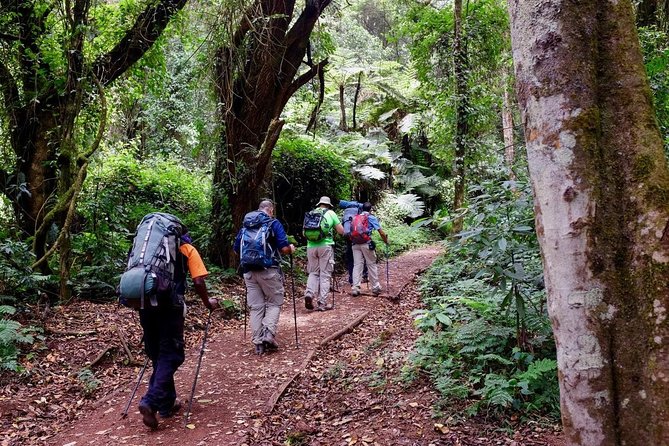
Day 5 is about eight hours and includes the most distinctive climbing of the route before summit night. You begin by descending into the head of the Great Barranco, then climb the Barranco Wall.
The wall is steep, long, and tiring, but it is described as a rock climb rather than a technical climb. You do not need mountaineering skills, though you do need balance, patience, and a willingness to move carefully. This is not a place for rushing or worrying about how quickly other people climb.
Beyond the wall, the trail passes beneath the Heim and Kersten glaciers before reaching the Karanga Valley. From there, the route climbs again toward Barafu Camp at 4,640 meters.
The final section crosses bare scree with no vegetation. It is steep and demanding, and altitude makes every step feel more expensive. Once at Barafu, you eat and rest for the afternoon in preparation for the midnight summit start.
This is the day when a private group can help. You can keep a steady rhythm without being pushed into someone else’s pace. The guide team also matters here, since the day requires careful timing before a long night ahead.
Day 6: Stella Point, Uhuru Peak, and the long descent
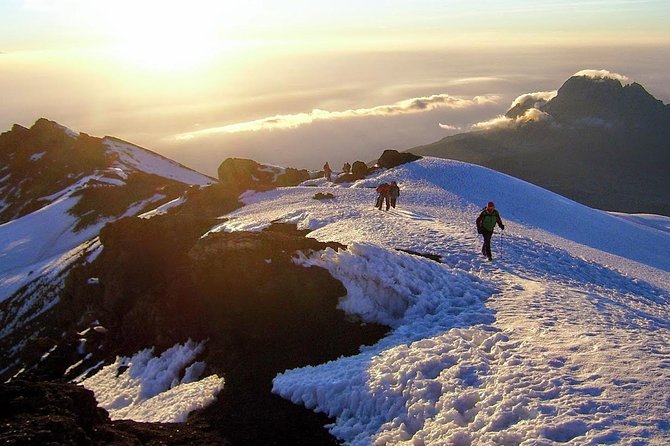
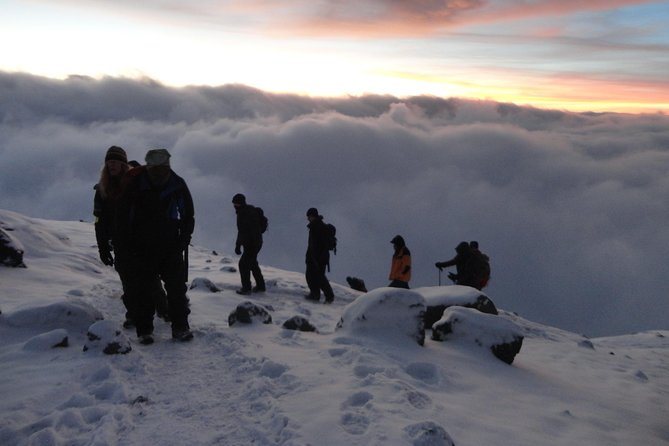
Summit day begins around midnight. You climb steeply through scree for four to five hours, gaining a great deal of height over a short distance.
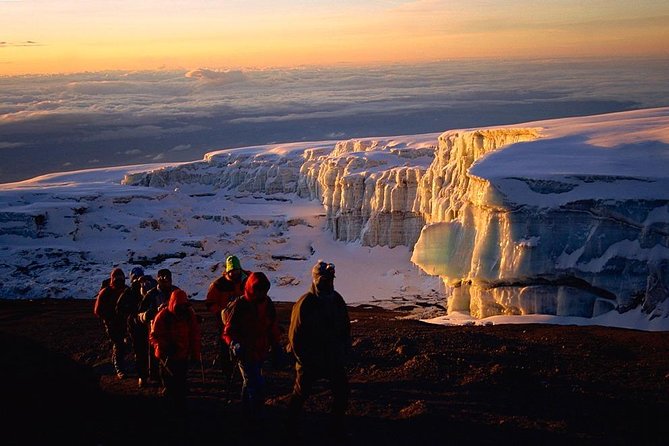
The goal is Stella Point on the crater rim at 5,739 meters. If the timing and weather cooperate, you may reach it around sunrise. The views from the rim include ice cliffs inside the crater, Mawenzi Peak, and the wide country beyond.
From Stella Point, you walk for about another hour to Uhuru Peak at 5,895 meters. Reaching the summit is a major physical achievement, but the summit itself is only part of the day. You still need to return to Stella Point, descend the scree to Barafu for breakfast, and continue down to Mweka Camp.
The full day is estimated at 13 to 15 hours. That figure should guide your decision to book. You need moderate physical fitness at a minimum, and you should be comfortable with long uphill and downhill walks. The route does not describe a technical summit climb, but altitude, cold, darkness, and exhaustion create serious challenges.
Emergency oxygen and a basic first aid kit are carried for emergencies only. Oxygen is not provided as a shortcut to the summit or as routine summit support. Personal insurance and health insurance are not included, so arrange those before arriving in Tanzania.
The distance is listed as about 16.4 kilometers, but the time and altitude gain tell the real story. This is a full mountain day, not an ordinary hike of that length.
Day 7: Mweka descent and return to Moshi
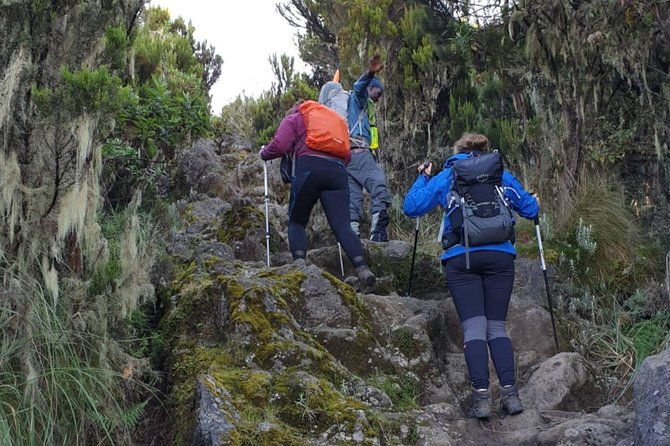
After the summit effort, the final descent passes through rainforest toward Mweka Gate. The listed walking time is about four to six hours, depending on the exact section and pace.
The forest feels like a major change after the dry high country. You complete park formalities at the gate and receive certificates before vehicle transport returns you to your Moshi hotel.
The schedule describes the final mountain overnight as Mweka Camp before the walk out. The important practical point is that you return to Moshi after park formalities, with a hotel night included. A shower, dinner, and a cold drink will feel well earned.
The descent is easier on your breathing than summit night, but do not assume it is easy on your knees. Trekking poles can be useful if you own them, and careful footwear matters on the downhill path.
What the $2,465.76 price really covers
At first glance, $2,465.76 per person is a large sum. The value improves when you count what is built into the package.
You receive airport transfers between Kilimanjaro International Airport and Moshi, plus a hotel night before and after the climb. Dinner and breakfast are included on those hotel nights, which removes two practical tasks after a long flight and after the descent.
On the mountain, the cost includes park fees and taxes, six breakfasts, seven lunches, and six dinners. A cook prepares the meals, while a guide, assistant guides, porters, and the wider mountain crew support the climb.
Fresh drinking water and hot water for washing are supplied each day. Emergency oxygen and a basic first aid kit are also included, but only for emergencies.
The package does not include flights, visas, travel insurance, health insurance, personal equipment, snacks, medicine, water-purifying tablets, or meals and drinks not specified. A portable toilet is optional but highly recommended, and rental gear may be available from the company’s equipment store in Tanzania.
That list is important because personal gear can add a noticeable amount to your total. Ask for rental prices before you travel, and plan for tips to the mountain crew even though the supplied information does not state a tip amount.
Service, organization, and the human side
The strongest praise attached to this trip concerns preparation, flexibility, and the crew. Tony described Wence and Intrepid Explorer Tanzania as flexible after a family health issue forced a postponement from January 2019. The company deferred the trip for more than a year without charging for the change.
That detail tells you something useful about communication when plans go wrong. It does not guarantee that every future change will receive the same treatment, but it is a positive sign for a company handling a complex climb.
A German-language account describes the climb as a once-in-a-lifetime experience and specifically praises the preparation, organization, and team. The crew is described as competent, cheerful, and committed. Those qualities matter on a route where morale can drop quickly around Barafu and during the summit night.
The published rating is 5 from two experiences. That is encouraging, but the sample is small. I would treat it as a good sign rather than proof that every part of the operation will be perfect.
Who should choose this Kilimanjaro climb?
I would recommend this route to you if you want a private, well-supported climb with a longer approach across the western side of Kilimanjaro. It suits people who value gradual acclimatization, varied scenery, and a route that does not simply rush toward the summit.
It is also a good fit if you appreciate having airport transfers, hotel nights, meals, a cook, porters, and a full guide team arranged in advance. The private format may work especially well for couples, families with suitable fitness, or a group of friends who want to share one demanding goal.
I would hesitate if you dislike very long hiking days, sleeping at high altitude, steep scree, or basic mountain conditions. You should also reconsider if you expect a relaxed sightseeing holiday. The summit day alone requires strong commitment.
Free cancellation is available if you cancel at least 24 hours before the local start time. Cancellations inside that window are not refundable, and late changes are not accepted.
Should you book it?
Book this Lemosho trek if you want a serious seven-day Kilimanjaro climb with a quieter opening, a sensible altitude profile, and extensive support included in the price. The western wildlife possibility, Shira Plateau views, Lava Tower ascent, Barranco Wall, and sunrise summit create a varied route rather than a single long uphill march.
Before paying, confirm the exact hotel arrangements, rental gear costs, crew tipping expectations, and the portable toilet option. If you are comfortable with the midnight summit push and the 13 to 15-hour summit day, this is a strong choice. If that sounds overwhelming, choose a longer Kilimanjaro itinerary instead of trying to force this seven-day schedule.
FAQ
Where does the Lemosho Route trek begin?
The trek begins at Londorossi Gate on the western side of Mount Kilimanjaro. After registration, you are driven another 12 kilometers to the trailhead.
How long does the Kilimanjaro trek last?
The experience lasts about seven days. It includes the climb, the summit attempt, the descent to Mweka, and the return to a hotel in Moshi.
Is pickup included?
Yes. Pickup from your hotel in Moshi is offered, and return airport transfers between Kilimanjaro International Airport and Moshi are included.
What is the highest point reached?
The summit is Uhuru Peak at 5,895 meters. On Day 4, the route reaches Lava Tower at 4,640 meters, and Barafu Camp is also at about 4,640 meters.
Is the Barranco Wall a technical climb?
The Barranco Wall is steep, long, and tiring, but it is described as a climb over rock rather than a technical climb.
Are meals included?
Yes. The package includes six breakfasts, seven lunches, and six dinners. A cook prepares meals on the mountain, while hotel dinner and breakfast are included for the nights before and after the climb.
What equipment and medical supplies are not included?
Personal trekking gear, snacks, personal medicine, and water-purifying tablets are not included. Emergency oxygen and a basic first aid kit are supplied for emergencies only. Personal travel and health insurance are also not included.
More Treks in Moshi
- Best Kilimanjaro hiking day trip tour with Kilinge Adventures
★ 4.5 · 54 reviews - #1. Best Kilimanjaro Day hike Tour-Machame Route-ISMANI
★ 4.2 · 47 reviews - Best Kilimanjaro Adventure 7 days Machame route Trekking
★ 5.0 · 42 reviews - Kilimanjaro 7 Day Private Trekking Experience
★ 5.0 · 40 reviews
Just added in Moshi
- Zanzibar: Stone Town tour and Nakupenda beach with Lunch★ 5.0 · 1 review
- day trip lake manyara★ 5.0 · 2 reviews
- Mt Kilimanjaro 6 days Marangu route hike★ 5.0 · 3 reviews
- machame route★ 5.0 · 16 reviews
- Private Cycle to Kilimanjaro Bike Park Safari★ 5.0 · 6 reviews
- West Kilimanjaro cycling Adventures★ 4.5 · 8 reviews
- Wildlife Extravaganza: Manyara, Tarangire & Ngorongoro in 3 Days★ 5.0 · 3 reviews
- 3 Days Private E-Bike Tour in West Kilimanjaro★ 5.0 · 3 reviews
Lemosho Route Climbs, compared.


8-Day Small-group Lemosho Kilimanjaro Summit Trekking
Read our review →



Climbing Kilimanjaro through 8 days Lemosho Route
Read our review →Browse the lists this tour appears in