
Reviewed · CAMPING SAFARIS
6 Day Private Camping Safari
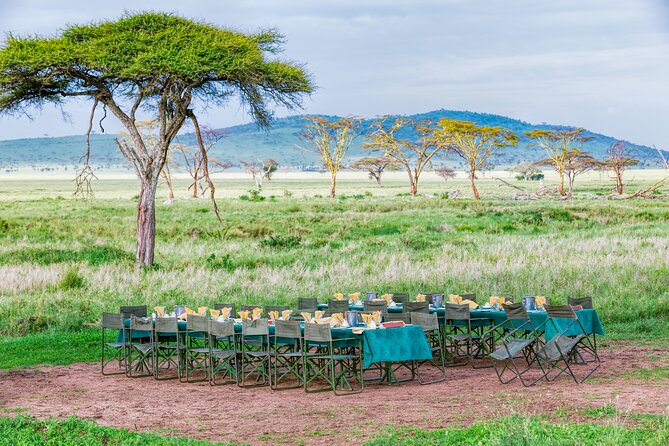
Africa rewards patience. This six-day private safari gives you time for Tanzania’s best-known northern parks, from bird-filled Lake Manyara to the wide grasslands of the Serengeti, then on to Ngorongoro Crater and Tarangire. I especially like the private format, since only your group takes part, and the route includes two full Serengeti days rather than treating the park as a quick stop. The price is also appealing for an all-in safari at $2,300 per person, though you should check exactly what camping accommodation includes before booking.
I also like the range of wildlife settings. Lake Manyara brings forest, escarpment, and lake views; Ngorongoro offers a compact area known for dense animal populations; and Tarangire is a strong finish for elephant families and baobab trees. The main drawback is the pace: you cover a lot of ground in six days, and the first and final days involve airport transfers or a park visit rather than a relaxed start or finish.
In This Review
- Key points at a glance
- What the $2,300 price covers
- Day 1: Arriving in Arusha
- Day 2: Lake Manyara beneath the Rift Valley escarpment
- Day 3: Entering the open country of Serengeti
- Day 4: A second Serengeti game-drive day
- Day 5: Ngorongoro Crater and the search for black rhino
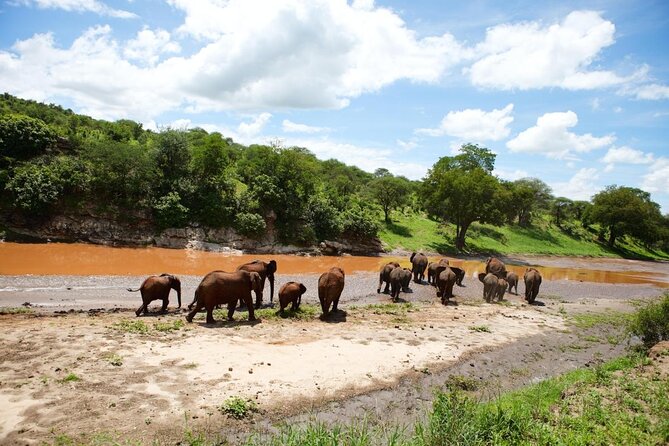
- Day 6: Elephants and baobabs in Tarangire
- Guides, private travel, and the human side
- Who should book this safari?
- Should you book the six-day route?
- FAQ
- Where does the safari begin?
- What time does the safari start?
- Is this a private tour?
- Which national parks and areas are included?
- What meals are included?
- Are flights and visas included?
- What is the cancellation policy?
Key points at a glance
- Two days in Serengeti National Park: Extra time gives you a better chance to see changing scenery and wildlife behavior.
- A private safari for your group: You do not share the activity with other parties.
- Four major Northern Circuit parks: The route includes Lake Manyara, Serengeti, Ngorongoro, and Tarangire.
- Camping with core meals included: Six breakfasts plus five lunches and five dinners are covered.
- Airport pickup and drop-off: Transfers are offered from Kilimanjaro International Airport or Arusha Airport.
- Strong guide praise: Elias, Laurian, and Cornelius are named in the supplied feedback, with Cornelius receiving particular praise for knowing the parks well.
What the $2,300 price covers
At $2,300 per person, this is not a budget day trip. It is a six-day, private safari with transportation, park-related fees and taxes, accommodation, airport transfers, and most meals. That makes the price easier to judge than a simple per-day figure, because many of the large costs of a Tanzania safari are already bundled in.
You receive six breakfasts, five lunches, and five dinners. Drinks at the camps are not included, and neither are tips, flights, visas, medical insurance, or travel insurance. Any extra night in Arusha after the safari is also outside the package.
I see the value mainly in the private vehicle arrangement and the route. A shared group safari may cost less, but a private trip gives your party more control over the pace and avoids joining strangers. The data does not specify the vehicle type, the number of people your vehicle can hold, or the exact camps, so ask for those details before paying.
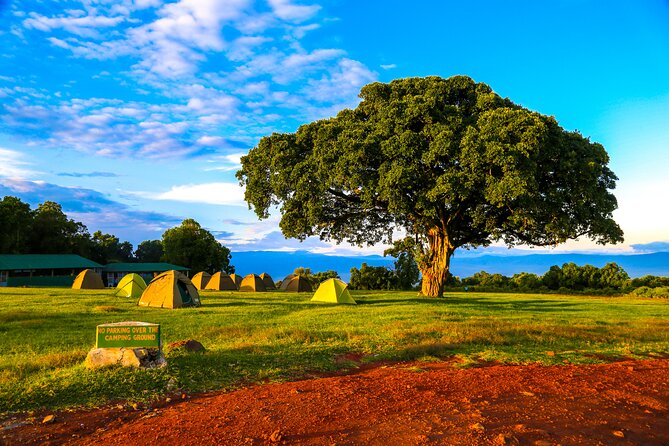
The word camping can mean different things in Tanzania. The information confirms accommodation and meals, but it does not explain whether the tents are simple public-campsite tents, upgraded safari tents, or another style. That distinction matters for comfort, storage, bathrooms, and the feel of each night.
More Camping Safaris in Moshi
- 4 Days Group Joining Camping Safari to Tarangire Serengeti Ngorongoro Crater
★ 5.0 · 50 reviews - 4 days adventure camping safari
★ 5.0 · 44 reviews - 6 Days Tanzania Budget Camping Safari with Migration
★ 5.0 · 31 reviews
Day 1: Arriving in Arusha
Your safari begins with a pickup at Kilimanjaro International Airport or Arusha Airport. A representative from Safaris Africa United meets you and drives you to your Arusha accommodation, where you spend the night before the park visits begin.
This first night is useful after a long international flight. You are not expected to leave immediately for Manyara, and the overnight stop gives you time to get settled before an early breakfast and road departure.
The meeting time is listed as 6:00 am, so you need to plan carefully if you are arriving that morning. The supplied details describe airport pickup and arrival transfer, but they do not clearly explain how a same-day arrival fits with the 6:00 am start. If your flight arrives on Day 1, confirm the timing directly.
The itinerary gives Day 1 an estimated five hours, likely reflecting the airport transfer and arrival arrangements. Since no post-safari night in Arusha is included, you should also make your onward flight plans with care.
Day 2: Lake Manyara beneath the Rift Valley escarpment
After breakfast, you travel to Lake Manyara National Park for an early game drive. The park is compact compared with Serengeti, yet its scenery changes quickly. The western side is framed by the steep Rift Valley escarpment, while the shallow, alkaline lake spreads across the eastern part of the park.
Manyara is especially noted for birdlife and tree-climbing lions. During the rainy season, thousands of flamingos may gather around the lake. The park also shifts from savannah to evergreen forest, giving you a different setting from the open plains that come later.
The park’s name comes from the Maasai word emanyara, a plant used to build the protective enclosure around a family homestead, known as a boma. It is a small detail, but it adds useful local context to a place that can otherwise seem like a short stop on the way to Serengeti.
I like this first park because it gives you variety without requiring several days. You might see birds, larger mammals, and the famous lions in trees, all with the escarpment and lake nearby. The limitation is time. The itinerary lists about five hours for the stop, so you should not expect the same extended searching time that you get in Serengeti.
Day 3: Entering the open country of Serengeti
Day 3 takes you toward Serengeti National Park after breakfast. This is the longest-awaited section of the route for many people, and the park earns its reputation through scale. Its open grasslands make wildlife easier to spot in some areas, while other sections bring different vegetation and less open views.
Serengeti is Tanzania’s oldest national park and part of an ecosystem that has remained largely unchanged for millions of years. Its fame is closely tied to the annual movement of wildebeest, zebra, and antelope in search of fresh grazing.
Do not treat migration timing as fixed. Rainfall controls the movement, so the exact location of the herds changes from year to year. A safari that visits outside the period or area you expected can still offer wildlife, but you should not book on the assumption that a particular herd crossing is guaranteed.
The strongest design choice here is the two-night Serengeti program. One day can feel rushed after the long approach, while two days let you spend more time looking for animals across different areas. The schedule still lists about five hours for the park stop, so ask how game-drive hours and the overnight location are arranged.
The private setup is useful in Serengeti. Your group can discuss how long to stay at a sighting with the guide, within park rules and the day’s driving plan. The information does not promise a dedicated vehicle of a particular size, so confirm what private means in practical terms.
A different kind of day out entirely:
- Kilimanjaro climb by Lemosho Route (7-day)
★ 5.0 · 651 reviews - Safari Serengeti And Ngorongoro
★ 5.0 · 288 reviews - Kilimanjaro climb, Machame Route (7-day)
★ 5.0 · 262 reviews - Kilimanjaro Climbing Lemosho Route 8 Days.
★ 5.0 · 186 reviews
Day 4: A second Serengeti game-drive day
The second Serengeti day is where this safari gains much of its value. You are not simply passing through on the way to Ngorongoro. You have another scheduled day to search for wildlife and take in the park’s broad grasslands.
Serengeti is known for abundant wildlife, but nature does not follow a script. Some sightings may be quick, while others may involve a long wait. That is why an extra day matters. It gives you more time for the park’s changing conditions rather than placing all your hopes on one drive.
The supplied feedback gives the guides an important role. Elias and Laurian are praised for guiding a multigenerational group of nine, while Cornelius is singled out for his knowledge of parks including Arusha, Tarangire, Ngorongoro, Serengeti, and Manyara. Those names are useful when you communicate with the operator. You can ask if one of them is available, though availability is not guaranteed.
The safari is described as camping, and the practical experience depends heavily on camp location and setup. Ask how much time is spent driving between camps and parks, what sleeping arrangements are provided, and whether you need to bring personal camping gear. Those details are not supplied, so they should be part of your pre-trip questions.
Day 5: Ngorongoro Crater and the search for black rhino
After an early breakfast, you continue with a game-drive route inside Serengeti before heading to Ngorongoro Crater. This en-route portion is a smart use of time. Instead of leaving the park without another chance to see wildlife, you get one more stretch of Serengeti before the next major setting.
Ngorongoro Crater looks almost like a separate world when viewed from above. Steep volcanic walls surround open savannah, acacia woodland, lakes, and swamps. The crater formed when a large volcano exploded and collapsed two to three million years ago.
Its appeal is both geological and zoological. The enclosed area supports dense populations of large mammals, and the itinerary specifically calls out the possibility of searching for black rhino. That is an exciting goal, but it is still a possibility, not a promise. Wildlife sightings depend on the day and the animals’ movements.
The drive down into the crater is part of the experience, but it also adds a practical issue: this is another early and active day after Serengeti. If you prefer slow mornings and long stays in one place, this route may feel demanding. If you want several major Tanzanian sights in one trip, the variety is worth the effort.
The supplied feedback describes Cornelius as a strong guide with a good understanding of the parks and their biology. That matters at Ngorongoro, where knowing the area can help your group make better use of limited time.
Day 6: Elephants and baobabs in Tarangire
The final park is Tarangire National Park, named for the Tarangire River that runs through it. During the dry season, the river is the only water source for wildlife in the area, drawing animals toward it.
Tarangire is known for elephant families and baobab trees. You may also see giraffe, bushbuck, hartebeest, lions, leopards, and a wide range of birds. The plant life changes from elephant grass and acacia woodland to groundwater forest, so this final day does not feel like a repeat of Serengeti.
I like ending here because Tarangire offers a different visual rhythm. Serengeti is about wide grasslands and long views. Tarangire brings thicker vegetation, a river, large elephant groups, and the unmistakable shape of baobabs.
The trade-off is that Day 6 combines a park visit with the end of the safari. The listed timing is about five hours, and the activity ends back at the meeting point. Confirm the exact drop-off plan if you have an onward flight, since the supplied information does not give a final hour.
Guides, private travel, and the human side
The most praised part of the supplied feedback is the care provided by the team. One account describes airport pickup, six days of support, a strong sense of safety, and guides who knew the terrain well. Another describes a group of nine people from three generations, with Elias and Laurian guiding the trip.
A Spanish-language account praises the company for arranging a honeymoon and for treating the couple like family. Another gives Cornelius special credit for knowing many corners of the parks and for understanding their biology.
Those details suggest an operator that puts real weight on personal service. Still, I would ask for the name of your assigned guide before departure, along with the accommodation plan and vehicle details. A private safari can be excellent, but its quality depends on the guide, vehicle, camp setup, and how clearly the operator handles the schedule.
Who should book this safari?
This trip suits you if you want the classic Northern Circuit in a single six-day program. It is a strong fit for couples, families, and private groups that value having only their own party on the activity.
It also suits people who want more than one Serengeti day. The route gives you a good spread of scenery and wildlife: birds and tree-climbing lions at Manyara, open country in Serengeti, black rhino possibilities at Ngorongoro, and elephants at Tarangire.
You may want a longer or slower safari if you dislike early starts, extended road travel, or changing camps. You should also look elsewhere if you need luxury lodging, because the supplied information confirms camping but does not describe an upgraded tented camp.
At $2,300 per person, I consider the package worth serious consideration for a private, meal-inclusive safari with airport transfers and four major parks. The value depends on the exact accommodation and vehicle, so get those details in writing before booking.
Should you book the six-day route?
Book it if your priority is variety, private travel, and a solid amount of Serengeti time without planning each transfer yourself. The strongest reasons are the two Serengeti days, the mix of four very different parks, and the care associated with guides such as Cornelius, Elias, and Laurian.
Think twice if you want a relaxed holiday with little time on the road. This is an active itinerary with early breakfasts, park transfers, camping, and a final safari day before returning to the meeting point.
Free cancellation is available if you cancel at least 24 hours before the experience begins. Changes or cancellations inside that period are not accepted for a refund.
FAQ
Where does the safari begin?
The safari begins at Kilimanjaro International Airport, on Kilimanjaro Airport Road, Tanzania. Pickup is also offered from Arusha Airport for domestic flights.
What time does the safari start?
The listed start time is 6:00 am.
Is this a private tour?
Yes. Only your group takes part in the activity.
Which national parks and areas are included?
The route includes Lake Manyara National Park, Serengeti National Park, the Ngorongoro Conservation Area and Crater, and Tarangire National Park. The first night is in Arusha.
What meals are included?
The package includes six breakfasts, five lunches, and five dinners.
Are flights and visas included?
No. Flights and visas are not included. Medical insurance and travel insurance are also excluded.
What is the cancellation policy?
You can cancel at least 24 hours before the experience start time for a full refund. Cancellations or changes made less than 24 hours before the start are not refunded or accepted.
Just added in Moshi
- Zanzibar: Stone Town tour and Nakupenda beach with Lunch★ 5.0 · 1 review
- day trip lake manyara★ 5.0 · 2 reviews
- Mt Kilimanjaro 6 days Marangu route hike★ 5.0 · 3 reviews
- machame route★ 5.0 · 16 reviews
- Private Cycle to Kilimanjaro Bike Park Safari★ 5.0 · 6 reviews
- West Kilimanjaro cycling Adventures★ 4.5 · 8 reviews
- Wildlife Extravaganza: Manyara, Tarangire & Ngorongoro in 3 Days★ 5.0 · 3 reviews
- 3 Days Private E-Bike Tour in West Kilimanjaro★ 5.0 · 3 reviews
Camping Safaris, compared.
3 Days Serengeti & Ngorongoro Group Camping Safari
Read our review →
2 Days Tarangire and Ngorongoro Group Camping Safari
Read our review →
3 Days Tarangire, Ngorongoro & Lake Manyara Group Camping Safari
Read our review →
5-Day private Camping Safari Tour in Tanzania
Read our review →
Browse the lists this tour appears in