
Reviewed · RONGAI ROUTE CLIMBS
Kilimanjaro Climbing Rongai Route
Africa’s highest summit rewards patience. Habari Adventure’s seven-day Rongai Route reaches Kilimanjaro from the quieter northeastern side, with gradual early walking, striking views of Mawenzi, and a demanding midnight push to Uhuru Peak. I like the route’s steady acclimatization plan and the chance of seeing zebra, elephant, buffalo, and monkeys near the forest. I also like the strong focus on local guides, safety, first aid, and natural and cultural knowledge.
The main caution is summit day. You may walk for about 15 hours, beginning around midnight and continuing from Kibo Hut to Gilman’s Point, Uhuru Peak, and Horombo Hut. That is a serious physical test, even with a slow pace and supportive guides. The $2,840.39 price is substantial, but it covers a full seven-day climb with park access shown throughout the itinerary, mountain camps, meals described along the route, transport arrangements, and a crew that past climbers praised for organization and care.
In This Review
- Key points about the Rongai Route
- Starting at Nalemoru Gate near the Kenyan border
- Day two reaches 3,450 meters at Second Cave Camp
- Day three crosses moorland toward Mawenzi
- Day four camps beneath Mawenzi at 4,330 meters
- Day five crosses the saddle to Kibo Hut
- Summit night begins at midnight
- Day seven descends through Mandara and rainforest
- Why the guides matter on this climb
- What $2,840.39 means in practical terms
- Who should choose this route
- Booking, cancellation, and weather details
- Should you book the seven-day Rongai Route?
- FAQ
- Where does the Rongai Route climb begin?
- How long is the Kilimanjaro Rongai Route experience?
- What time does the experience start?
- Is pickup available?
- How large can the group be?
- What fitness level is required?
- How high is Uhuru Peak?
- How long is summit day?
- What happens if poor weather cancels the climb?
Key points about the Rongai Route
- A quieter approach from Nalemoru Gate: The climb begins near the Kenyan border, away from the busiest southern routes.
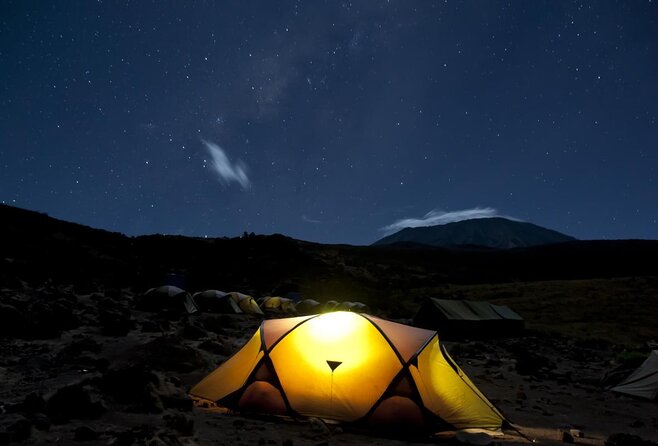
- A seven-day ascent with useful acclimatization time: You sleep at 3,450 meters, 4,330 meters, and 4,700 meters before the summit attempt.
- Mawenzi provides the route’s most dramatic scenery: The trail passes beneath its jagged spires and camps directly below the volcanic peaks.
- Summit night is long and steep: Expect a midnight start, roughly five hours to Gilman’s Point, another hour to Uhuru Peak, then a long descent.
- Local guides are a major part of the experience: Habari Adventure’s team includes guides trained in safety and first aid, with expertise in flora, fauna, geography, history, archaeology, anthropology, and astronomy.
- The group limit is 15 people: That keeps the outing from becoming a huge expedition, though the exact group size may vary.
Starting at Nalemoru Gate near the Kenyan border
Your morning begins after breakfast, with a drive from Moshi toward Nalemoru Gate. The route starts on Kilimanjaro’s northeastern side, close to the Kenyan border, and gives you a different opening from the more commonly used approaches.
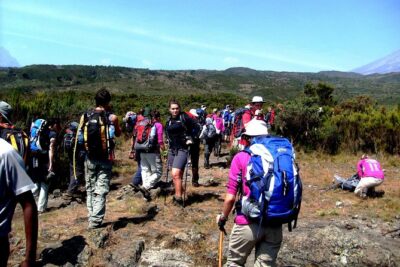
The first walk is a gradual three-hour climb through rainforest. That gentle start matters. You are not thrown straight into a steep ascent, and you have time to settle into the slow walking rhythm that will guide the whole week.
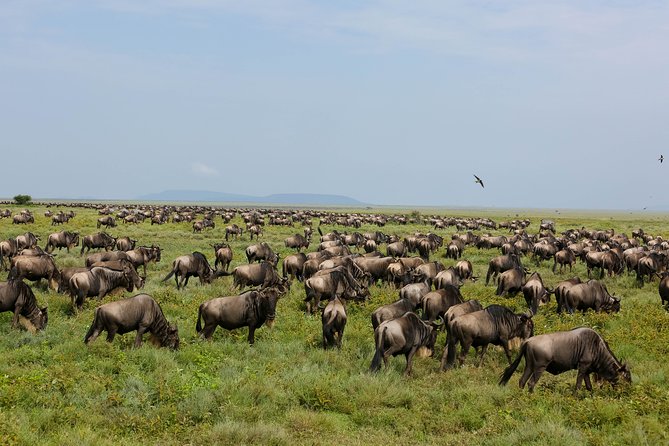
The forest also gives you the first chance for wildlife sightings. Zebra, elephants, buffalo, and monkeys may appear, but sightings are not guaranteed. Keep your expectations sensible. The bigger reward is the change in setting as you move from forest toward higher, more open ground.
Habari Adventure offers pickup, and the stated start time is 8:00 am. The meeting information names Kilimanjaro Airport and Kilimanjaro National Park, while the daily plan describes departure from a Moshi hotel. I would confirm the exact pickup location and transfer details before arrival.
More Kilimanjaro climbs:
- Kilimanjaro climb by Lemosho Route (7-day)
★ 5.0 · 651 reviews - Kilimanjaro climb, Machame Route (7-day)
★ 5.0 · 262 reviews - Kilimanjaro Climbing Lemosho Route 8 Days.
★ 5.0 · 186 reviews
Day two reaches 3,450 meters at Second Cave Camp
Day two takes about four hours and climbs into the moorland zone. Your destination is Second Cave Camp, also called 2nd Cave Camp, at roughly 3,450 meters.
This is where the mountain begins to feel less like a forest walk and more like a high-altitude expedition. The views open toward Kibo, Kilimanjaro’s highest volcanic cone, and its eastern ice fields. You get an early look at the summit area without yet facing the steepest ground.
The camp altitude is useful for acclimatization, but it may also bring the first signs of altitude stress. Walk slowly, drink as directed by your guide, and report headaches, nausea, unusual tiredness, or other problems early. A guide cannot remove altitude risk, but a trained guide can help the group respond wisely.
Day three crosses moorland toward Mawenzi
The third day lasts about five hours. You continue across the moorland, following a smaller path toward Mawenzi, the sharply ridged volcanic peak that rises to about 5,140 meters.
The eastern ice fields on Kibo remain part of the view, but Mawenzi becomes the star of the day. Its jagged peaks give the route a more rugged feel, and the trail’s quieter character becomes clearer as you move away from the lower forest.
Lunch and the night are at Kikelelwa. The itinerary describes this as a scenic day, and the appeal is easy to understand: you are walking between two major volcanic forms, with Kibo and Mawenzi presenting very different faces of Kilimanjaro.
Do not judge the day only by its distance. At altitude, five hours can feel much longer than a similar walk at home. The best approach is to keep your pace slow and even, rather than trying to use your energy early.
Day four camps beneath Mawenzi at 4,330 meters
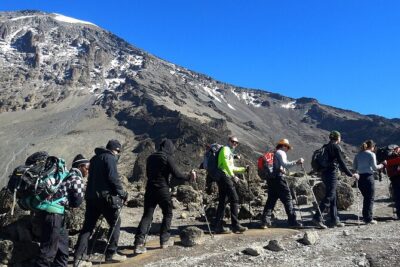
Day four is shorter, at about four hours, but it includes a steep climb up grassy slopes. The effort pays off with broad views in every direction and a strong sense of being far from ordinary roads and towns.
Mawenzi Tan Hut sits at around 4,330 meters in a cirque beneath Mawenzi’s towering spires. This is one of the route’s most memorable camp locations. You are not simply stopping at a generic mountain shelter. You are spending the night below one of Kilimanjaro’s most distinctive volcanic peaks.
The afternoon is free for rest or a short exploration of the surrounding area. That free time also helps with acclimatization. I would treat rest as part of the climb, not as wasted time. You have a much harder summit day ahead, and an afternoon of quiet recovery may be more useful than extra wandering.
The camp’s altitude is also a clear warning that the mountain is becoming serious. You will be sleeping considerably higher than Second Cave Camp, so pay attention to how your body responds.
More Rongai Route climbs:
- Kilimanjaro climb, Rongai Route (7-day)
★ 5.0 · 40 reviews - Kilimanjaro climb, Rongai Route (6-day)
★ 5.0 · 15 reviews - Mount Kilimanjaro Rongai Route
★ 5.0 · 10 reviews - 6-Day Rongai Route Trek in Mount Kilimanjaro
★ 5.0 · 8 reviews
Day five crosses the saddle to Kibo Hut
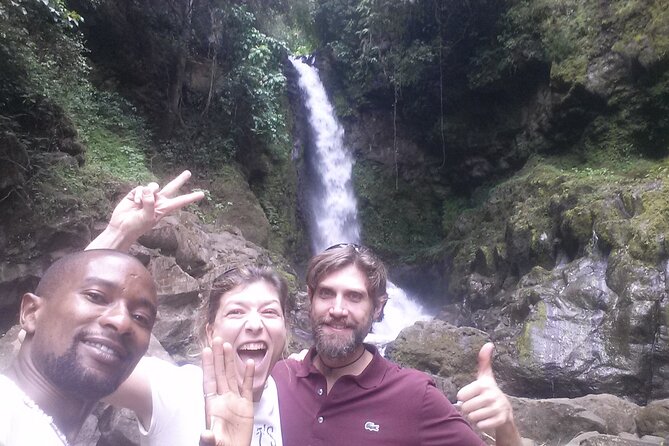
The fifth day covers about five hours across the lunar-looking saddle between Kibo and Mawenzi. Vegetation gives way to a bare, open high-altitude zone, and the two volcanic peaks frame the crossing.
The destination is Kibo Hut, where you eat lunch and rest through the afternoon before the final ascent. The plan is simple: conserve every bit of energy for the midnight start.
This is often an emotionally strange part of a summit climb. You have reached the last camp, but the main test has not yet begun. Rest may be difficult because of altitude, anticipation, or the unusual schedule. Follow the guides’ instructions and use the afternoon to prepare clothing, water, and any personal equipment you need for the night.
The altitude schedule is one of the best reasons to choose seven days instead of rushing up the mountain. You still face a demanding ascent, but you have had several nights to gain height gradually.
Summit night begins at midnight
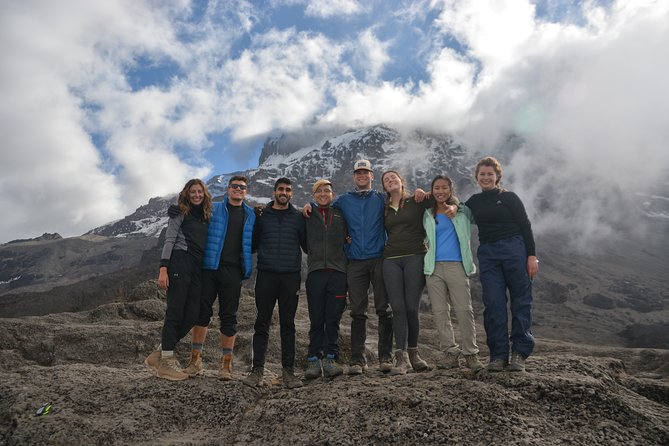
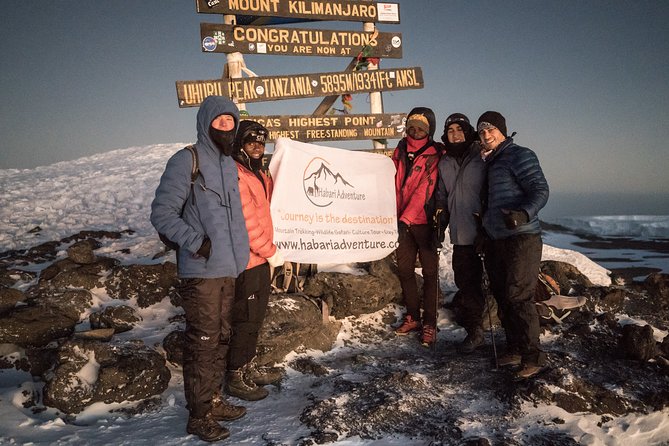
Day six is the hardest part of the Rongai Route. You start around midnight and climb steeply in darkness. The itinerary allows roughly five hours to reach Gilman’s Point at 5,685 meters.
The guides set a very slow pace. That may feel almost comically slow at first, but it is exactly what you need. At this altitude, moving too quickly can burn energy fast and make the climb harder than necessary. The key is steady progress, not speed.
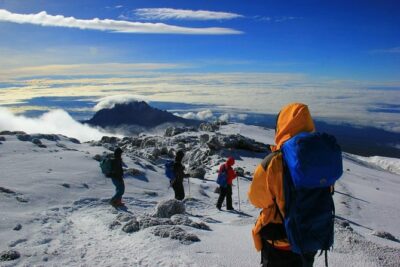
At Gilman’s Point, you get a short rest and tea while watching sunrise over Mawenzi. This is a powerful moment because the peak that has accompanied you since the moorland is now below and across the crater area.
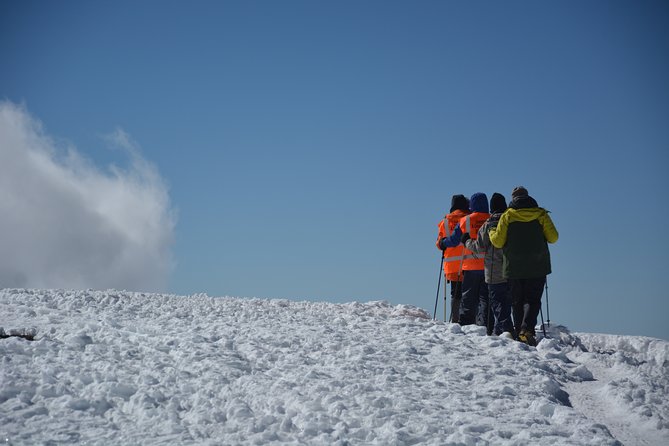
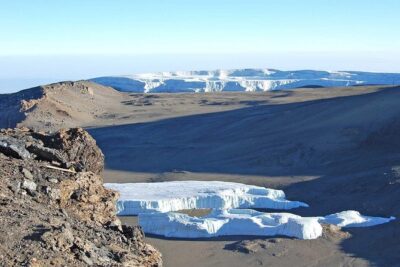
From Gilman’s Point, the route continues for nearly an hour to Uhuru Peak at 5,895 meters. Near the summit, you pass close to glaciers and ice formations that still occupy much of the summit zone. Conditions and visibility can vary, but the route promises a close look at Kilimanjaro’s remaining high ice.
After photos at the top of Africa, you descend to Kibo Hut for a short rest and hot lunch. Then you continue to Horombo Hut at about 3,700 meters. The full day takes around 15 hours, which is why I would not treat the summit as the only challenge. The descent is part of the endurance test, and tired legs can make downhill walking surprisingly difficult.
This is also the point where the quality of your guide team matters most. Habari Adventure emphasizes local guides trained in first aid and safety. The strongest praise for the company centers on guides who were patient, encouraging, organized, and attentive. Emmanuel and Innocent received especially warm recommendations, while Leon was praised for making a solo climber feel safe and at home.
Day seven descends through Mandara and rainforest
The final day takes about seven hours. You descend through heath and moorland to Mandara Hut at approximately 2,700 meters, stopping there for a hot lunch.
From Mandara, the trail continues down through tropical rainforest to Kilimanjaro National Park Gate. The scenery changes quickly, and the return to thicker vegetation gives you a clear sense of how much altitude you gained during the week.
At the gate, you collect your certificates and complete park formalities. A car then takes you back to your Moshi hotel, where a warm shower and a proper celebration await.
The end is practical as well as satisfying. You do not finish at a remote trailhead and then have to arrange your own way back. Still, confirm the final transfer details in advance, especially if you have a same-day connection or another activity planned.
Why the guides matter on this climb
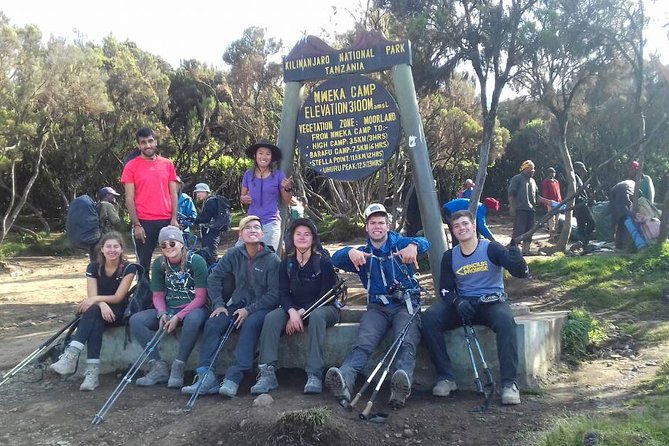
A Kilimanjaro route is not only a walking itinerary. It is a managed high-altitude experience, and the guide team shapes nearly every important decision.
Habari Adventure’s guides are local to Kilimanjaro and other parts of Tanzania. Their stated training includes safety and first aid, while their subject knowledge covers plants, animals, geography, history, archaeology, anthropology, and astronomy. That range can make the slow hours on the trail more interesting and help you understand the mountain beyond its summit height.
The company’s past praise is especially strong in three areas:
- Support: Solo climbers and less experienced hikers felt cared for.
- Organization: The seven-day climb was described as well arranged from start to finish.
- Food and group spirit: The meals and friendly crew helped make the long days more manageable.
The guide names Emmanuel, Innocent, and Leon are worth noting if you are choosing a guide service. You cannot assume a particular guide will lead your departure, but you can ask Habari Adventure about the available team.
The maximum group size is 15. That is small enough to avoid the feel of a giant procession, though a group of 15 can still spread out on steep ground. If personal attention is important to you, ask how many guides and support staff will be assigned to your specific departure.
What $2,840.39 means in practical terms
At $2,840.39 per person, this is not a budget mountain walk. The value depends on what you want from the trip and on the level of support you need.
The price is easier to assess when you look at the full structure. You receive a seven-day route with gradual altitude gains, guided access through Kilimanjaro National Park, overnight mountain camps, planned meals including hot lunch stops, summit assistance, and return transport to Moshi. The itinerary shows admission tickets included for each day.
The price also buys planning and risk management. A strong team sets the walking pace, handles park procedures, organizes the camp-to-camp progression, and supports you during the most difficult section. For a first major mountain climb, that structure can be worth more than shaving money off the booking price.
Still, do not assume every personal expense is covered simply because the itinerary lists admission tickets and meals. Before paying, ask Habari Adventure for a written list of inclusions and exclusions, including equipment, tips, airport transfers, accommodation before and after the climb, and emergency arrangements. Those details are not fully specified here.
Who should choose this route
I would recommend the Rongai Route to someone who wants a seven-day Kilimanjaro climb with a quieter approach, strong views of Mawenzi, and a gradual route profile before summit night.
It suits you best if you:
- Have a moderate level of physical fitness
- Can walk for several hours on consecutive days
- Are prepared for a steep, cold, dark summit attempt
- Value patient guides and a supportive crew
- Like a route that changes from rainforest to moorland, high desert, and summit ice
- Prefer a group capped at 15 people
It may not suit you if you dislike long mountain days, struggle with steep climbs, or want a relaxed holiday with only short walks. The 15-hour summit day is not a minor detail. You should train for sustained walking and take the altitude schedule seriously.
Solo climbers can also consider this trip. One person who joined during the off-season ended up as the only climber in the group and still described the experience as safe and welcoming. Group size can change, so do not count on either a large team or a private departure.
Booking, cancellation, and weather details
Confirmation is provided at booking, and the activity offers mobile tickets. Pickup is available, but the stated meeting details and the Moshi hotel departure description should be checked together before you arrive.
You can cancel for a full refund if you do so at least 24 hours before the scheduled start time. Changes or cancellations made inside that 24-hour window are not accepted for a refund. The local time in Tanzania controls the cutoff.
The climb depends on suitable weather. If poor weather forces cancellation, you are offered another date or a full refund. That policy is useful for a mountain trip, where conditions can affect safety and operations.
Should you book the seven-day Rongai Route?
I would book this climb if you want a carefully paced Kilimanjaro experience and place a high value on guide support. The route gives you a strong mix of rainforest, moorland, Mawenzi views, the Kibo to Mawenzi saddle, and a classic sunrise summit attempt.
I would not book it without first confirming the complete cost, pickup point, equipment arrangements, and guide staffing. The price is high, but the organization, local leadership, food, and personal support can make it fair value for a serious climb.
If you are fit enough for the long summit day and ready to walk slowly, rest often, and respect the mountain, Habari Adventure’s Rongai Route looks like a sound choice. If you want a gentle holiday, choose something else. Kilimanjaro is beautiful, but it does not give away Uhuru Peak cheaply.
FAQ
Where does the Rongai Route climb begin?
The climb begins at Nalemoru Gate near the Kenyan border after departing from Moshi.
How long is the Kilimanjaro Rongai Route experience?
The planned duration is approximately seven days.
What time does the experience start?
The stated start time is 8:00 am.
Is pickup available?
Yes, pickup is offered. The daily plan describes departure from a hotel in Moshi.
How large can the group be?
The activity has a maximum group size of 15 people.
What fitness level is required?
A moderate physical fitness level is recommended.
How high is Uhuru Peak?
Uhuru Peak reaches 5,895 meters.
How long is summit day?
The summit day takes approximately 15 hours, beginning around midnight and ending at Horombo Hut after the descent.
What happens if poor weather cancels the climb?
You will be offered a different date or a full refund.
Just added in Moshi
- Zanzibar: Stone Town tour and Nakupenda beach with Lunch★ 5.0 · 1 review
- day trip lake manyara★ 5.0 · 2 reviews
- Mt Kilimanjaro 6 days Marangu route hike★ 5.0 · 3 reviews
- machame route★ 5.0 · 16 reviews
- Private Cycle to Kilimanjaro Bike Park Safari★ 5.0 · 6 reviews
- West Kilimanjaro cycling Adventures★ 4.5 · 8 reviews
- Wildlife Extravaganza: Manyara, Tarangire & Ngorongoro in 3 Days★ 5.0 · 3 reviews
- 3 Days Private E-Bike Tour in West Kilimanjaro★ 5.0 · 3 reviews
Rongai Route Climbs, compared.
Rongai Route 6 Days 5 Nights/Kilimanjaro climb
Read our review →
6 Days Kilimanjaro climbing | Hiking Tour via the Rongai Route
Read our review →
6 Days Mount Kilimanjaro Climbing via Rongai Route
Read our review →Browse the lists this tour appears in