
Reviewed · RONGAI ROUTE CLIMBS
Rongai Route 6 Days 5 Nights/Kilimanjaro climb
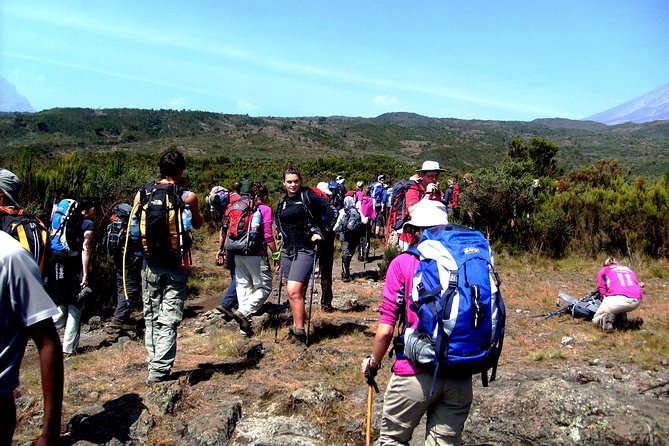
Africa begins above the clouds. This six-day Kilimanjaro climb approaches from the quieter northern side, passing through farmland, pine forest, moorland, high desert, and the summit zone before descending through Marangu. I like the less crowded northern approach and the wide views toward Kenya, along with the strong attention to permits, transfers, guides, and mountain logistics praised in the supplied feedback. The main caution is the pace: summit day can last 10 to 16 hours, and the route reaches 5,895 meters in only six days.
The trip costs $1,850 per person and includes camping equipment, park fees, crew wages, meals, accommodation, and airport transfers. That is a solid package price for a guided Kilimanjaro climb, but you should still confirm exactly which accommodation nights and airport transfers are covered before paying. The route name can also confuse you: today’s northern trail is commonly called Rongai, though it is also known as the Loitokitok or Nalemuru route.
In This Review
- Five things to know before booking
- Why the northern Rongai approach is different
- Day one: Nale Moru, pine forest, and Kenyan views
- Day two: Second Cave and the first serious altitude gain
- Day three: Mawenzi Tarn and a useful acclimatization walk
- Day four: Crossing the saddle to Kibo Hut
- Day five: Gilman’s Point, Uhuru Peak, and the long descent
- Day six: Forest descent to Marangu Gate
- What the $1,850 price covers
- Guides, crew, and the human side of the climb
- The main tradeoffs to consider
- Who should choose this climb?
- Should you book the Rongai Route?
- FAQ
- Where does the Rongai Route climb begin?
- How long is the Kilimanjaro climb?
- What time does the experience start?
- Is pickup available?
- What is included in the price?
- What is not included?
- How difficult is the climb?
- How many people can join the group?
- Can I cancel for a full refund?
Five things to know before booking
- The modern Rongai trail begins near Nale Moru, not at the old Rongai border village.
- Day five is the test, with a midnight start, a summit attempt, and a long descent to Horombo.
- You cross two very different sides of Kilimanjaro, climbing from the dry north and descending through the forest toward Marangu.
- The route offers a quieter feel, a useful advantage for anyone hoping for more privacy than the busiest trails.
- The package covers the costly basics, including park fees, camping gear, crew wages, meals, accommodation, and transfers.
- The group limit is 15 people, so this is not a private climb unless you book accordingly.
Why the northern Rongai approach is different
Many people call this the Rongai Route, but the name is not quite exact. The original trail began near Rongai village on the Kenya border and was closed several years ago. The northern route used today begins near Nale Moru and is also called the Loitokitok Route.
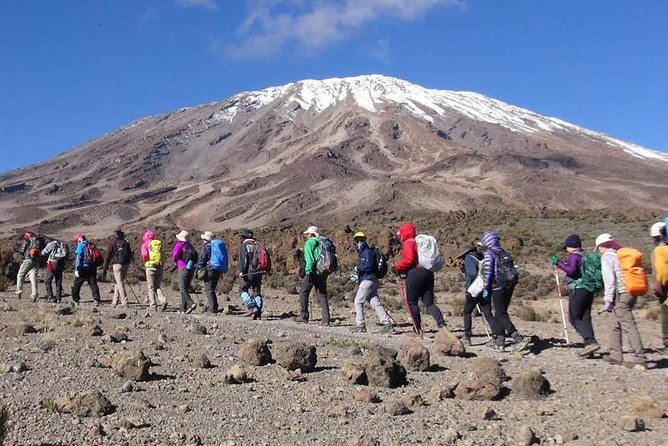
Along the trail, signs may call it the Nalemuru or Nalemoru Route. Names aside, the practical point is simple: you are climbing Kilimanjaro from the north, where the scenery and feel differ from the more familiar southern approaches.
This side of the mountain is known for broad views toward the Kenyan plains. It also gives you a climb with a different entrance and exit, since the descent uses the Marangu side. That variety matters. You are not simply walking up and back through the same scenery.
The northern side is also chosen by people hoping to avoid the busiest routes. The supplied feedback repeatedly praises the sense of privacy, the scenery, and the care taken by the support team. One party specifically chose Rongai for a quieter climb with a fiancé, while another group selected it to avoid crowded trails.
Do not mistake quieter for easy. Kilimanjaro remains a serious high-altitude climb. The highest camp is at 4,700 meters, and the summit is 5,895 meters above sea level. You need a moderate level of fitness, patience, and the ability to keep moving for many hours.
More Kilimanjaro climbs:
- Kilimanjaro climb by Lemosho Route (7-day)
★ 5.0 · 651 reviews - Kilimanjaro climb, Machame Route (7-day)
★ 5.0 · 262 reviews - Kilimanjaro Climbing Lemosho Route 8 Days.
★ 5.0 · 186 reviews
Day one: Nale Moru, pine forest, and Kenyan views
Your morning begins with breakfast at your hotel, followed by collection by the head guide. The drive takes you to Kilimanjaro National Park for registration, then onward by vehicle to the village of Nale Moru at roughly 1,950 meters.
The first walk lasts about three to four hours. You begin along a small path through fields of maize and potatoes, then enter pine forest. It is a pleasant introduction, with a gradual rise rather than an immediate wall of mountain.
The forest can be wet, so keep your waterproof jacket and trousers in your daypack. Do not bury them in your main luggage. Rain can arrive quickly, and stopping to open a large pack is an unnecessary nuisance on the first day.
As you climb, the forest gives way to moorland. The best reward is the view over the Kenyan plains. This early change in vegetation helps you understand Kilimanjaro as a series of ecological zones, not just one long uphill walk.
The first day is short by mountain standards, which is useful. You have time to settle into the rhythm of walking, learn how the camp routine works, and notice how your body responds to altitude. Dinner and an overnight camp follow.
Day two: Second Cave and the first serious altitude gain
After breakfast, you walk toward the Kikelelwa Caves, with the route passing through Second Cave at approximately 3,450 meters. This is a longer day, listed at six to seven hours of walking, covering about 9 kilometers.
The ascent is steady rather than flat-out steep. You gain about 950 meters, ending the day near Kikelelwa Caves at around 3,800 meters. That is a meaningful jump from the first camp, so this is when you need to pay attention to hydration, appetite, sleep, and any altitude symptoms.
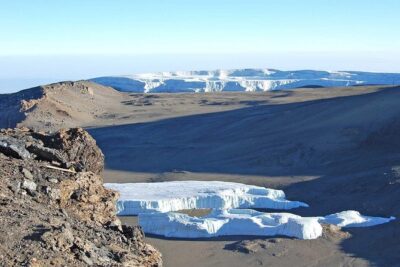
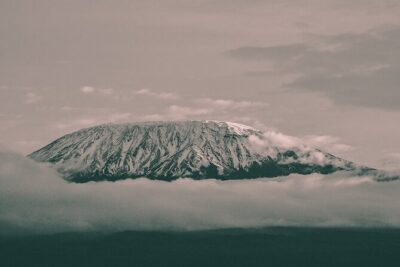
Weather permitting, you can see Kibo, Kilimanjaro’s main summit cone, as well as the eastern ice fields on the crater rim. These views give you a clear sense of the climb ahead. Kibo may look close, but high-altitude distances are deceptive.
This is a good day to use a slow pace. You do not gain anything by racing into camp, especially when the next morning reaches 4,330 meters. Keep your personal essentials close: water, rain gear, sun protection, snacks, and an extra layer.
Day three: Mawenzi Tarn and a useful acclimatization walk
Day three is shorter, at about three to four hours and 6 kilometers. It is not effortless. The trail leaves the remaining vegetation behind and includes some steeper sections over grassy slopes.
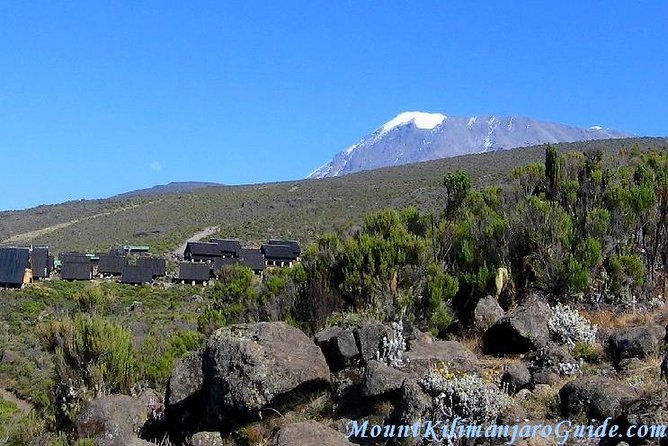
The reward is a stronger feeling of isolation and wide views in every direction. You finish near Mawenzi Tarn Hut at 4,330 meters, below Mawenzi, Kilimanjaro’s jagged second-highest peak.
An afternoon acclimatization walk reaches about 4,500 meters before you return to camp. This is one of the most useful parts of the schedule. You climb higher for a short period, then sleep lower than that high point, giving your body a chance to adjust.
The camp near Mawenzi Tarn is among the most distinctive locations on the route. It sits in a stark high-altitude setting, with the rocky Mawenzi massif nearby. Conditions can feel exposed and cold, so warm layers and a sleeping bag suited to the mountain are important.
The package includes camping equipment, but I would still ask the operator what sleeping bags, mattresses, and tents are supplied. The phrase camping equipment is broad, and comfort at 4,000 meters depends heavily on the quality of that gear.
More Rongai Route climbs:
- Kilimanjaro climb, Rongai Route (7-day)
★ 5.0 · 40 reviews - Kilimanjaro climb, Rongai Route (6-day)
★ 5.0 · 15 reviews - Mount Kilimanjaro Rongai Route
★ 5.0 · 10 reviews - 6-Day Rongai Route Trek in Mount Kilimanjaro
★ 5.0 · 8 reviews
Day four: Crossing the saddle to Kibo Hut
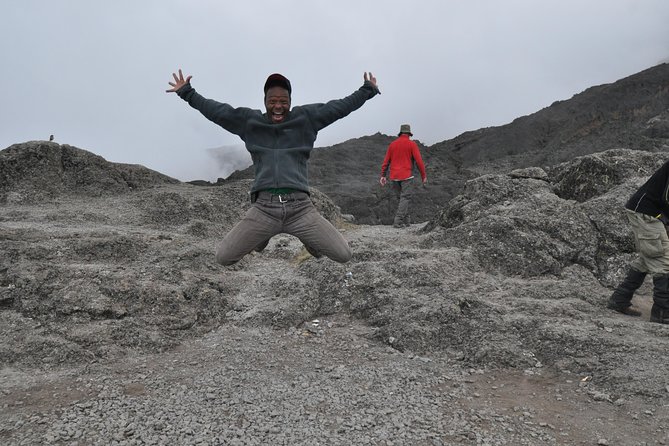
The fourth day crosses the lunar desert between Mawenzi and Kibo, Kilimanjaro’s two highest peaks. You walk about 9 kilometers in four to five hours, gaining another 370 meters before reaching Kibo Hut at 4,700 meters.
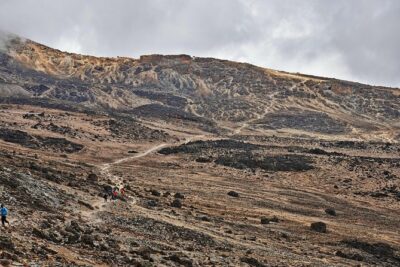
This is a spare, stark section of the mountain. Vegetation disappears, and the route becomes a long high-altitude crossing. The saddle may look simple on a map, but at this elevation every step takes more effort.
An early dinner is followed by an overnight stay at Kibo Hut. This is not the place for a late night. Your summit attempt begins around 1 a.m., so organize your clothing, headlamp, water, and small snack before trying to sleep.
The high camp is useful because it shortens the distance to the summit. It also creates the hardest sleep of the trip for many people, simply because you are resting at 4,700 meters. Do not expect a normal night. The goal is to rest as much as possible and save energy for the climb.
Day five: Gilman’s Point, Uhuru Peak, and the long descent
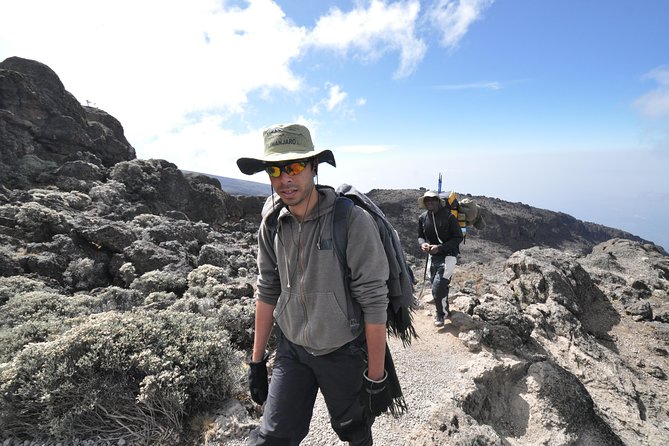
This is the day that defines the whole climb. You wake at about 1 a.m. for a hot drink and snack, then begin walking by torchlight.
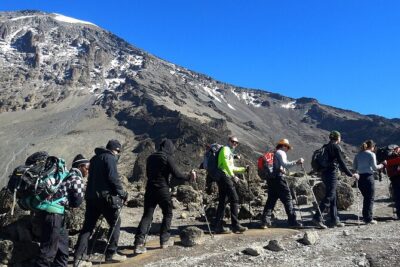
The pace is deliberately slow. You climb toward Gilman’s Point on the crater rim at 5,685 meters. Reaching Gilman’s Point is a major achievement, but the route continues if you are able.
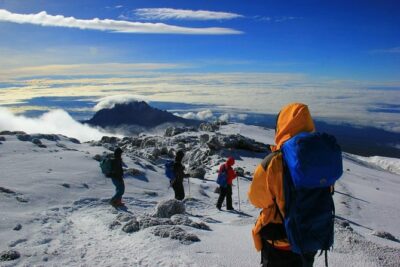
A short rest there gives you time to watch sunrise over Mawenzi Peak. The view is likely to be one of the most memorable moments of the trip, though mountain weather can always affect visibility.
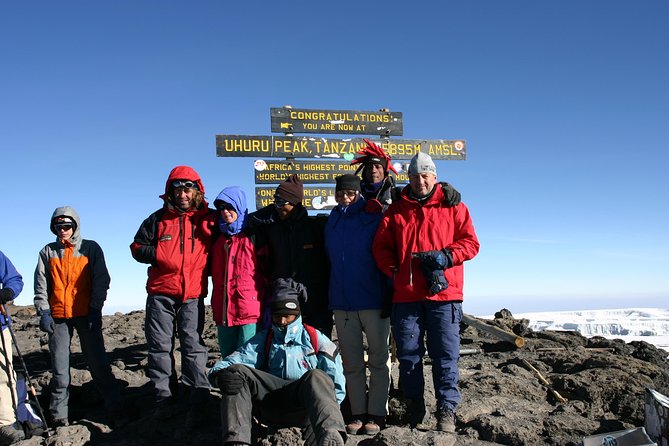
From Gilman’s Point, you continue toward Uhuru Peak at 5,895 meters, the highest point in Africa. The final section can feel much harder than the numbers suggest. You are already tired, the air is thin, and the climb has been underway for hours.
After the summit, you descend to Kibo Hut at 4,700 meters for brunch and a rest. Then you continue down to Horombo Hut at 3,720 meters. The total walking time may range from 10 to 16 hours, with around 5 kilometers of ascent and 15 kilometers of descent.
This is why I would not book this route simply because it has six days. The schedule is efficient, but efficiency means a demanding summit day. If you have never done a long mountain day, train with extended walks and back-to-back hikes before arriving in Tanzania.
The steep descent can be hard on knees and feet. Trekking poles may help, though the supplied information does not confirm whether they are provided. Bring footwear that is already broken in, not a brand-new pair purchased just before departure.
Day six: Forest descent to Marangu Gate
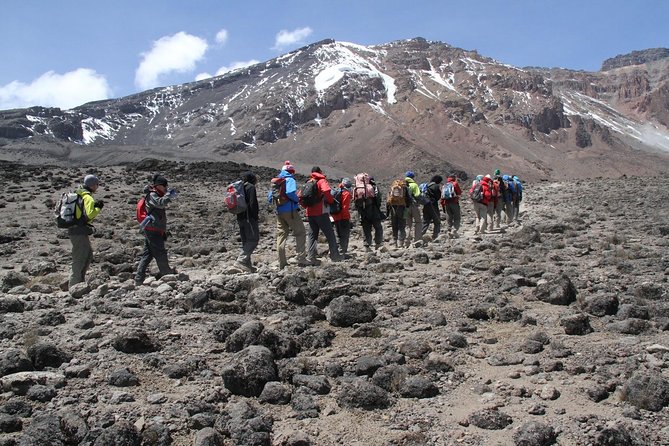
The final day involves about 20 kilometers of downhill walking, usually taking around five to seven hours. You descend from Horombo through lush forest on good paths to Marangu Park Gate at approximately 1,700 meters.
At the gate, you sign out of the mountain. A driver then transfers you to your hotel in Moshi or Arusha.
This descent is long, but it is a welcome change from the summit zone. Green forest replaces the bare upper slopes, and the air feels warmer and easier to breathe. Still, do not treat the final day as a casual stroll. After the summit push, your legs may be tired, and 20 kilometers is a substantial distance.
The route’s point-to-point design is especially convenient here. You finish at a different gate rather than retracing the northern trail, giving you a broader view of Kilimanjaro’s environments.
What the $1,850 price covers
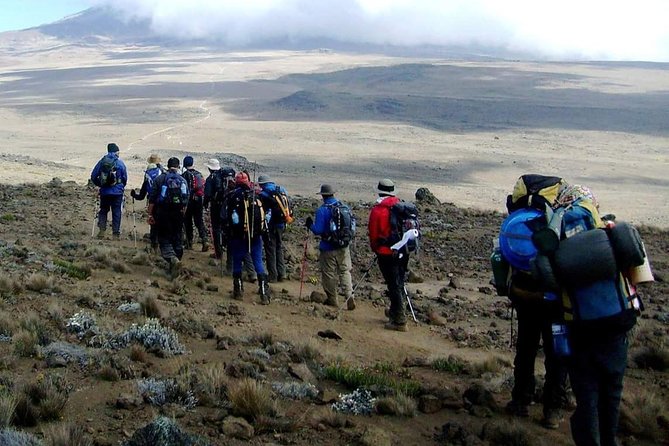
At $1,850 per person, the package includes the major expenses that can make a Kilimanjaro climb costly:
- Camping equipment
- All national park fees
- Crew salary
- Accommodation
- Airport transfers
- Six lunches
- Five dinners
- Five breakfasts
That is good value if all of those inclusions are delivered as expected. Park fees alone are a major part of any Kilimanjaro budget, and crew wages should not be treated as an optional extra.
The meal count matches the six-day structure in a general way, though you should ask how meals are handled on summit day. The schedule includes a hot drink and snack before the 1 a.m. start, then brunch after returning to Kibo Hut.
International flights, visas, alcohol, and soft drinks are not included. You should also confirm the exact hotel nights covered under accommodation and the details of airport pickup. The experience offers pickup and mobile ticketing, and the stated start time is 9 a.m., but the first collection time may depend on your hotel and transfer plan.
Guides, crew, and the human side of the climb
The most praised part of the operation is the support from the guides and the attention to logistics. Amos is identified as the director of Migration Venture Africa, and the feedback gives special mention to guides including Vitalis and Eric on Rongai climbs.
Other names connected with the company include Size Mrema and Nicholas Wiso, though the supplied comments link them to other Kilimanjaro routes. I would ask for the names and roles of your assigned guide team before departure.
That is not just a courtesy. Your guide controls the walking pace, helps manage the schedule, and becomes your main source of practical support on summit day. The strongest comments describe a company that handled permits, transfers, and trip details carefully from arrival through departure.
The group limit is 15 people. That is small enough to avoid the feel of a huge expedition, but it may not provide the quiet, private experience you imagine if the group fills. Ask how many people are booked for your date and how porters and guides are assigned.
Children must be accompanied by an adult. The stated fitness requirement is moderate, but the summit day makes this more demanding than a normal walking holiday. If you have a medical concern, seek professional advice before booking.
The main tradeoffs to consider
The route offers a quieter northern approach and striking views, but six days leaves limited time for altitude adjustment. Day three includes a useful acclimatization walk, yet the schedule still asks you to gain height quickly.
The scenery changes constantly, from crops and pine forest to moorland, high desert, and forest again. That variety is a major advantage. The tradeoff is that day two, day four, and especially day five require long, steady effort.
The package is also convenient because it gathers permits, meals, equipment, crew wages, accommodation, and transfers into one price. You should still ask for a written packing list and a clear description of the sleeping arrangements, since those details are not specified.
The company has earned a perfect five-star rating from seven supplied comments, with repeated praise for Amos, the mountain crew, careful planning, and memorable summit experiences. Seven comments are encouraging, but not a large sample, so I would treat them as a positive signal rather than a guarantee.
Cancellation is free if you cancel at least 24 hours before the local start time. Within 24 hours, no refund is offered, and late changes are not accepted.
Who should choose this climb?
I would point you toward this route if you want:
- A northern approach with broad Kenyan views
- A quieter feel than the busiest Kilimanjaro routes
- A six-day schedule with a clear summit plan
- A package that includes park fees, meals, crew wages, equipment, and transfers
- A guided climb with a maximum group size of 15
I would pause if you need a slower altitude schedule, dislike very long summit days, or want a private group guaranteed from the start. A six-day climb can work well, but it leaves less margin for a difficult response to altitude than a longer program.
Before booking, ask four practical questions: How many people are in my group? What camping equipment is supplied? Which hotel nights are included? What exactly is covered by airport transfer? Clear answers will tell you more than a glossy promise.
Should you book the Rongai Route?
Book it if the northern setting, quieter trail, and price matter more to you than having the longest possible acclimatization schedule. The route gives you varied scenery, a different approach and exit, and a well-organized package with the main mountain costs included.
I especially like the combination of Kenyan views, Mawenzi Tarn, the saddle to Kibo, and the Marangu forest descent. I also see real value in the reported care from Amos and guides such as Vitalis and Eric.
Just respect the hard parts. Summit day can last most of a day and night, and the final descent is long. Arrive fit, keep waterproofs handy, confirm the equipment and transfer details, and choose this climb because you are ready for a serious high-altitude effort, not because six days sounds easy.
FAQ
Where does the Rongai Route climb begin?
The modern northern route begins near the village of Nale Moru, at about 1,950 meters. It is also called the Loitokitok or Nalemuru Route.
How long is the Kilimanjaro climb?
The experience lasts approximately six days and five nights.
What time does the experience start?
The stated start time is 9:00 a.m.
Is pickup available?
Yes. Pickup is offered, and airport transfers are included in the package.
What is included in the price?
The $1,850 price includes camping equipment, all park fees, crew salary, accommodation, airport transfers, six lunches, five dinners, and five breakfasts.
What is not included?
International flights, visas, alcohol, and soft drinks are not included.
How difficult is the climb?
Participants should have a moderate level of physical fitness. The summit day is especially demanding, with an early morning start and total walking time that may range from 10 to 16 hours.
How many people can join the group?
The maximum group size is 15 people.
Can I cancel for a full refund?
Yes, if you cancel at least 24 hours before the local start time. Cancellations within 24 hours are not refunded, and changes made within 24 hours are not accepted.
Just added in Moshi
- Zanzibar: Stone Town tour and Nakupenda beach with Lunch★ 5.0 · 1 review
- day trip lake manyara★ 5.0 · 2 reviews
- Mt Kilimanjaro 6 days Marangu route hike★ 5.0 · 3 reviews
- machame route★ 5.0 · 16 reviews
- Private Cycle to Kilimanjaro Bike Park Safari★ 5.0 · 6 reviews
- West Kilimanjaro cycling Adventures★ 4.5 · 8 reviews
- Wildlife Extravaganza: Manyara, Tarangire & Ngorongoro in 3 Days★ 5.0 · 3 reviews
- 3 Days Private E-Bike Tour in West Kilimanjaro★ 5.0 · 3 reviews
Rongai Route Climbs, compared.
6 Days Kilimanjaro climbing | Hiking Tour via the Rongai Route
Read our review →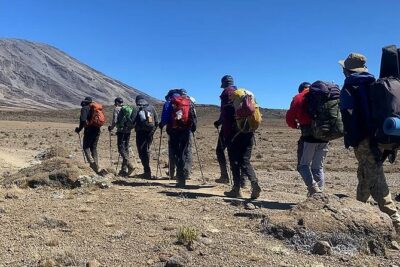
6 Days Mount Kilimanjaro Climbing via Rongai Route
Read our review →Browse the lists this tour appears in