
Reviewed · RONGAI ROUTE CLIMBS
Rongai Route 7 Days
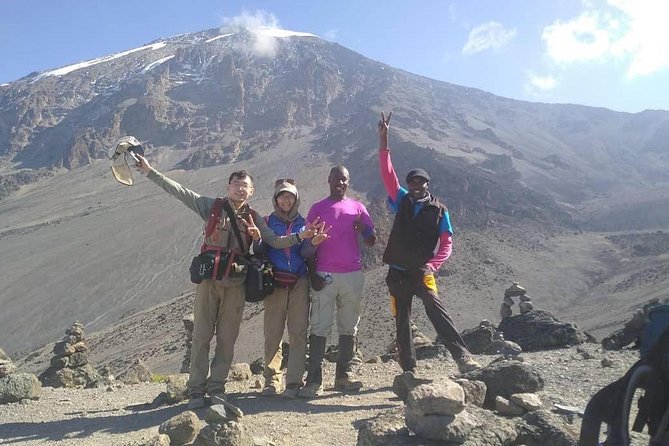
The quiet side of Kilimanjaro rewards steady walkers. The Rongai Route approaches Africa’s highest mountain from the Kenyan border, offering lighter crowds, a gradual climb, and long stretches of true wilderness. I like the northern setting and the route’s gentler rhythm, especially for hikers with limited backpacking experience. I also like that you descend by the Marangu Route, giving you different scenery on the way down.
The main tradeoff is that Rongai does not offer quite as much scenery variety as the western routes. You also need to be ready for a punishing summit day, with 12 to 15 hours of walking and a midnight start. At $2,923.08 per person, this is a serious purchase, but the price includes key mountain services that can make a major difference.
In This Review
- Key points about the 7-day Rongai climb
- Why Rongai is a smart alternative to Marangu
- Day 1: Nale Moru Gate to Simba Camp
- Day 2: Simba Camp to Second Cave Camp
- Day 3: Leaving the pine forest for Kikelewa Camp
- Day 4: Kikelewa Camp to Mawenzi Tarn Hut
- Day 5: Crossing the saddle to Kibo Hut
- Day 6: Uhuru Peak and the long descent to Horombo
- Day 7: Horombo Hut to Marangu Gate
- What the $2,923.08 price covers
- Who will like this route most
- Practical booking advice before you go
- Should you book the Rongai Route?
- FAQ
- Where does the Rongai Route begin?
- How long is the Rongai Route tour?
- What time does the tour start?
- Is airport pickup included?
- Is this a private tour?
- Are mountain guides and porters included?
- Are tents provided?
- Are sleeping bags and walking poles included?
- How difficult is the route?
- What happens if bad weather cancels the climb?
Key points about the 7-day Rongai climb
- Northern approach: Rongai is the only Kilimanjaro route that begins from the north, close to the Kenyan border.
- Lower trail traffic: You get a quieter mountain experience than on the popular Marangu route.
- Gradual early ascent: The first days build height at a manageable pace, which helps with acclimatization.
- Wilderness setting: Much of the route passes through pine forest, moorland, and open high-country terrain.
- Different descent route: You climb via Rongai and return through Marangu, so the trip does not simply retrace its steps.
- Private group format: Only your own group participates, with guides, a chef, and porters supporting the climb.
Why Rongai is a smart alternative to Marangu
Kilimanjaro has several routes, but Rongai offers something quite distinct. It approaches from the northern side, near Tanzania’s border with Kenya, rather than starting in the busy southern foothills. That gives the early trek a more remote feel and helps explain why this route is often chosen by people who want fewer crowds.
I especially like the gradual rise during the first few days. You do not rush from low altitude straight into the high mountain zone. Instead, the route moves from farmland and pine forest into moorland, then toward the volcanic terrain around Mawenzi and Kibo.
The route is considered moderately difficult and is recommended for people with less backpacking experience. That does not mean easy. You still need strong physical fitness, and the summit push is demanding for anyone. It means the route’s pacing is more forgiving than some alternatives, particularly before summit night.
Rongai is also a sensible choice during the rainy season because the northern side of Kilimanjaro receives less precipitation. Weather can still change quickly, and the experience requires good conditions, but the route has a practical advantage in wetter periods.
The scenery is not as varied as on some western approaches. You will not get a constant parade of dramatic changes every few hours. Instead, Rongai gives you quiet, open country and a strong sense of being away from roads and settled areas. I would choose this route for its calm pace and wilderness, not for the greatest possible range of scenery.
More Rongai Route climbs:
- Kilimanjaro climb, Rongai Route (7-day)
★ 5.0 · 40 reviews - Kilimanjaro climb, Rongai Route (6-day)
★ 5.0 · 15 reviews - Mount Kilimanjaro Rongai Route
★ 5.0 · 10 reviews
Day 1: Nale Moru Gate to Simba Camp
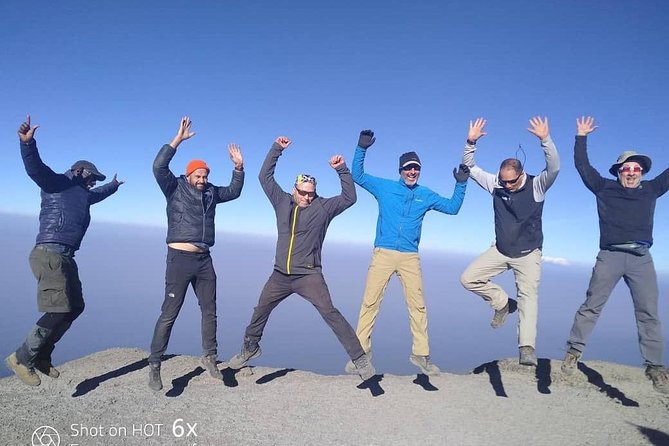
The day begins with an 8:00 am start and a drive to the village of Nale Moru. From there, you enter the Rongai route at Nale Moru Gate, located at about 1,990 meters.
The first 8 kilometers take around four to five hours. The trail passes through farmland and pine forest before reaching Simba Camp at 2,625 meters, at the edge of the moorland zone.
This is a pleasant first day because the elevation gain is steady rather than abrupt. You have time to settle into the walking pace, get used to the support team, and learn how the camp routine works. You might see colobus monkeys, and there is also a chance of elephants or buffalo along the way, although wildlife sightings are not guaranteed.
Simba Camp is important because it marks the first shift away from the cultivated lower slopes. You are still at a moderate altitude, but the surroundings begin to feel more open and mountain-focused.
Breakfast, lunch, and dinner are listed for the day. Camping is in private, waterproof, four-season mountain tents, with a separate mess tent furnished with a table and chairs.
Day 2: Simba Camp to Second Cave Camp
Day two covers only 5 kilometers, with three to four hours of walking. The short distance lets you focus on gaining altitude without burning too much energy.
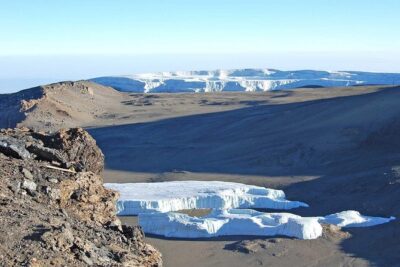
The trail climbs steadily through the moorland zone to Second Cave Camp at 3,480 meters. From here, the route offers views toward Kibo, the main volcanic cone of Kilimanjaro, including its eastern ice fields.
This is the kind of day that rewards patience. You may feel capable of walking faster, but a slow, measured pace is more useful than speed at altitude. The route description calls the ascent steady, and that is exactly what you want early in a high-altitude trek.
Second Cave Camp also gives you a useful acclimatization step. You sleep at a noticeably higher elevation than the night before, then continue climbing gradually rather than making one giant jump.
Day 3: Leaving the pine forest for Kikelewa Camp
The third day continues from Second Cave Camp at 3,480 meters to Kikelewa Camp at 3,630 meters. The supplied schedule gives about three hours for the walk, though it does not state the distance or list the meals separately for this day.
The route leaves the main trail and crosses moorland on a smaller path toward the jagged peaks of Mawenzi, Kilimanjaro’s second-highest volcanic cone. The views toward Kibo’s eastern ice fields continue, but the feel becomes more remote as the trees disappear.
Kikelewa Camp is a useful stopping point because the elevation gain is modest. The day is less about covering ground and more about moving your body into the high-altitude routine. You should still expect the air to feel thinner, particularly after even short uphill sections.
Because the published schedule is less detailed for this day, I would confirm the exact distance, meal plan, and camp arrangements before booking. That is a small but worthwhile check when you are paying for a seven-day climb.
A few more options to weigh up in Moshi
- Kilimanjaro climb by Lemosho Route (7-day)
★ 5.0 · 651 reviews - Safari Serengeti And Ngorongoro
★ 5.0 · 288 reviews - Kilimanjaro climb, Machame Route (7-day)
★ 5.0 · 262 reviews - Kilimanjaro Climbing Lemosho Route 8 Days.
★ 5.0 · 186 reviews
Day 4: Kikelewa Camp to Mawenzi Tarn Hut
Day four is 8 kilometers and takes about four to five hours. The trail climbs through grassy slopes, with a short but steep section that brings a reward: wide views toward the Kenyan plains.
Vegetation fades as you approach Mawenzi Tarn Hut at 4,310 meters. The camp sits beneath the steep cliffs of Mawenzi, one of the most striking formations on the mountain. The setting feels stark and high, with the volcanic rock rising above the camp.
This is one of the best days for acclimatization. After reaching camp, you have time to rest or explore the area. That afternoon pause matters. The trip is not simply a contest to reach the top as fast as possible. Your body needs time to adjust to the altitude, and the schedule builds in that breathing room.
The combination of a relatively short walking day and a rest period makes this stage valuable. You have climbed above 4,000 meters, but you are not yet forced into the summit push.
Day 5: Crossing the saddle to Kibo Hut
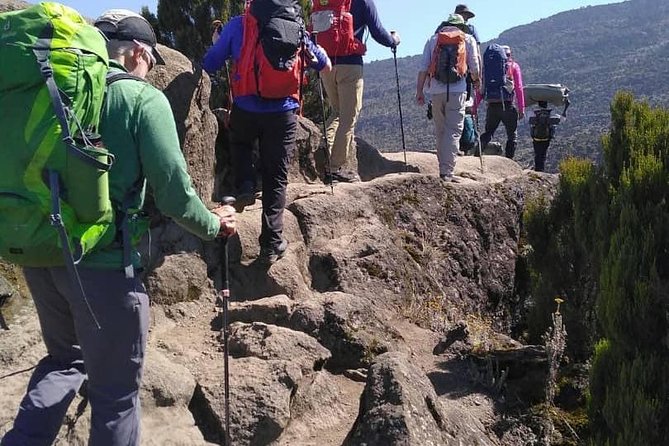
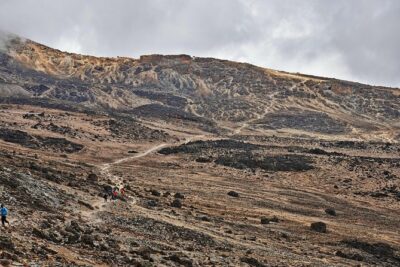
From Mawenzi Tarn Hut, the route crosses the volcanic saddle between Mawenzi and Kibo. The distance is 8 kilometers, and the walk takes about five to six hours.
This section is often described as a lunar desert, and the description fits the exposed, open character of the high mountain zone. There is little vegetation, and the trail stretches toward Kibo, with the summit visible ahead.
You reach Kibo Hut at 4,700 meters. The rest of the day is set aside for resting, eating, and preparing for the final ascent. An early night is planned, though sleeping at this height can be difficult for some people.
This is a day when good personal organization helps. Keep your summit clothing, water, and essential items ready before trying to sleep. The schedule calls for a very early night because the final ascent begins around midnight.
Day 6: Uhuru Peak and the long descent to Horombo
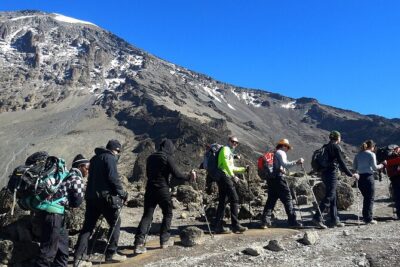
Day six is the hardest part of the trip. You leave Kibo Hut around midnight and climb toward Hans Meyer Cave at about 5,220 meters. The ascent continues slowly to Gillman’s Point at 5,681 meters, the crater rim.
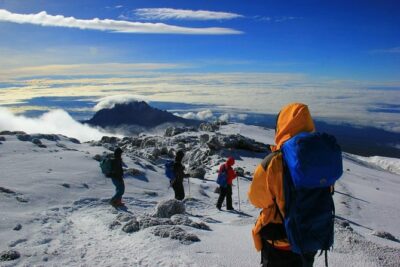
Reaching the rim around sunrise gives you a change in temperature and light after the cold darkness of the night. From Gillman’s Point, it takes another one to two hours to reach Uhuru Peak at 5,895 meters, the highest point on Kilimanjaro.
The full day covers 22 kilometers and lasts approximately 12 to 15 hours. That figure deserves your full attention. The summit is not the end of the day. After descending to Kibo Hut, you have a warm meal and a one to two-hour break, then continue down to Horombo Hut at 3,700 meters.
This schedule is physically severe. You should prepare for cold, fatigue, steep sections, and the effects of altitude. The route’s gradual first five days help, but they cannot make summit day easy.
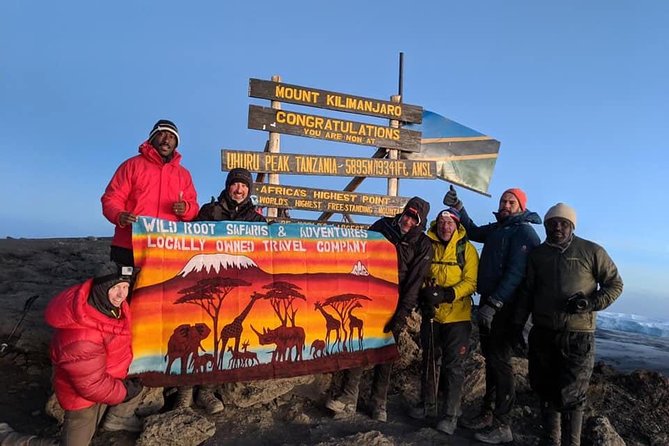
The support team is a major part of the value here. Guides, a chef, and porters are included, and the published feedback gives particular praise to the organization, food, logistics, and the team’s attention to safety. One Singapore group traveled under the leadership of Khoo Swee Chiow, while another praised the strong organization and helpful staff on a November 2018 climb. A separate safari and mountain arrangement was customized by a coordinator named Mathew.
Those details suggest an operator with experience handling mixed trips and international groups. Still, you should discuss your pace, fitness, and altitude concerns with the company before departure. Good logistics help, but they do not replace preparation.
Day 7: Horombo Hut to Marangu Gate
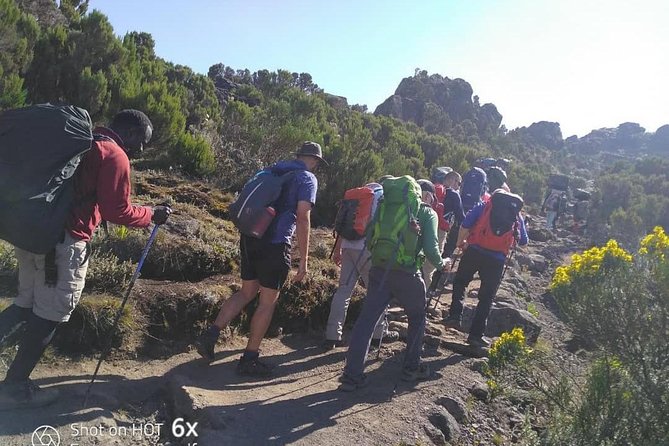
The final day begins at Horombo Hut, 3,700 meters, and descends 20.8 kilometers to Marangu Gate at 1,860 meters. The schedule allows about eight hours.
The trail passes through the heath and moor zones to Mandara Hut at 2,700 meters, where lunch is planned. After that, you return to the tropical rainforest and continue to the Kilimanjaro National Park gate.
This descent uses the Marangu side of the mountain, giving you a different view of Kilimanjaro from the one you saw on the ascent. It also makes the trip feel like a complete crossing rather than a return along the same trail.
After reaching the gate, you say goodbye to the guides and transfer to your hotel. The schedule says the transfer is to Arusha, while the tour location is listed as Moshi. I would confirm the final hotel destination and transfer arrangements before paying, especially if your accommodation or onward transport is in Moshi.
What the $2,923.08 price covers
At $2,923.08 per person, this is not a budget hike. The value depends on how much support you want and how much equipment you already own.
The package includes professional mountain guides, a chef, and porters’ allowances. It also includes airport pickup and drop-off, first and last accommodation, quality mess tents with tables and chairs, and private waterproof four-season sleeping tents.
The accommodation and support equipment matter more than they might on an ordinary trek. After a long day at altitude, a proper shelter and an organized meal area are practical comforts, not luxuries. Having a chef and porters also means you are not carrying the full camping setup while trying to conserve energy for the summit.
The itinerary lists breakfast, lunch, and dinner each day, while the included section specifically mentions seven dinners. Because of that difference, I would ask for written confirmation that all listed meals are included, particularly on the less detailed third day.
You must pay separately for your sleeping bag and walking poles. Tanzania visa costs, gratuity, and personal expenses such as laundry, phone use, and beverages are also excluded.
Before booking, price out the equipment you need. Renting or buying a suitable sleeping bag for high-altitude conditions can affect the real cost of the trip. The same goes for walking poles, which are not included but may be useful during the long descent.
Who will like this route most
I would recommend Rongai to you if you want a quieter Kilimanjaro experience and prefer a gradual climb. It suits hikers with strong fitness but less experience carrying a backpack over several days.
The private format is useful for couples, families, or a group of friends who want their own pace and arrangements. Only your group participates, so you are not placed into a larger public departure.
The route also suits people considering a climb during the rainy season, since the northern side receives less precipitation. That is a helpful advantage, not a promise of dry weather.
I would think twice if your main goal is the widest possible range of scenery or a short, easy summit attempt. Rongai is quieter, but the walking days still add up, and the summit day is long enough to test experienced hikers.
Practical booking advice before you go
The meeting time is 8:00 am. Airport pickup and drop-off are included, but confirm the airport, hotel location, and transfer timing directly with Wild Root Safaris and Adventures.
A strong physical fitness level is required. Prepare for long walking days, especially the 22-kilometer summit stage and the 20.8-kilometer descent to Marangu Gate.
Ask about the exact third-day distance and meals, and clarify the final transfer to Arusha or Moshi. Also confirm what the first and last accommodation includes, since those nights are part of the package.
The tour offers free cancellation up to 24 hours before the start time for a full refund. Changes or cancellations inside that 24-hour window are not accepted for a refund. If poor weather forces cancellation, you are offered another date or a full refund.
Should you book the Rongai Route?
Book it if you value quiet trails, gradual altitude gain, and strong camp support more than a constant parade of changing scenery. The route gives you a genuine northern approach, a remote wilderness feel, and a different descent through Marangu.
The price makes the most sense if you need airport transfers, accommodation, tents, a chef, porters, and experienced guides bundled together. I would confirm the meal details and final transfer location before making payment, then plan carefully for the cold, long summit night.
For a fit hiker seeking a less crowded Kilimanjaro route, Rongai is a practical and appealing choice. Just remember that a quieter route is not the same as an easy one.
FAQ
Where does the Rongai Route begin?
The route begins at Nale Moru Gate, at approximately 1,990 meters, after a drive to the village of Nale Moru near the Kenyan border.
How long is the Rongai Route tour?
The experience lasts approximately seven days.
What time does the tour start?
The stated start time is 8:00 am.
Is airport pickup included?
Yes. Airport pickup and drop-off are included.
Is this a private tour?
Yes. Only your group participates in the activity.
Are mountain guides and porters included?
Yes. Professional mountain guides are included, along with a chef and porters’ allowances.
Are tents provided?
Yes. The package includes private waterproof four-season mountain sleeping tents and quality mess tents with tables and chairs.
Are sleeping bags and walking poles included?
No. Sleeping bags and walking poles are not included.
How difficult is the route?
The route is described as moderately difficult, but you should have a strong physical fitness level. Summit day lasts approximately 12 to 15 hours.
What happens if bad weather cancels the climb?
If poor weather causes cancellation, you are offered a different date or a full refund.
Just added in Moshi
- Zanzibar: Stone Town tour and Nakupenda beach with Lunch★ 5.0 · 1 review
- day trip lake manyara★ 5.0 · 2 reviews
- Mt Kilimanjaro 6 days Marangu route hike★ 5.0 · 3 reviews
- machame route★ 5.0 · 16 reviews
- Private Cycle to Kilimanjaro Bike Park Safari★ 5.0 · 6 reviews
- West Kilimanjaro cycling Adventures★ 4.5 · 8 reviews
- Wildlife Extravaganza: Manyara, Tarangire & Ngorongoro in 3 Days★ 5.0 · 3 reviews
- 3 Days Private E-Bike Tour in West Kilimanjaro★ 5.0 · 3 reviews
Rongai Route Climbs, compared.
Rongai Route 6 Days 5 Nights/Kilimanjaro climb
Read our review →
6 Days Kilimanjaro climbing | Hiking Tour via the Rongai Route
Read our review →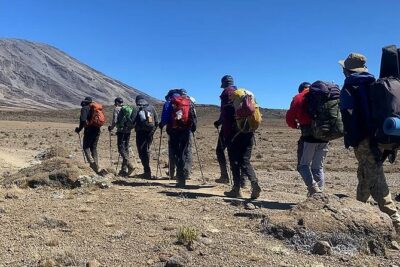
Browse the lists this tour appears in